Aperture
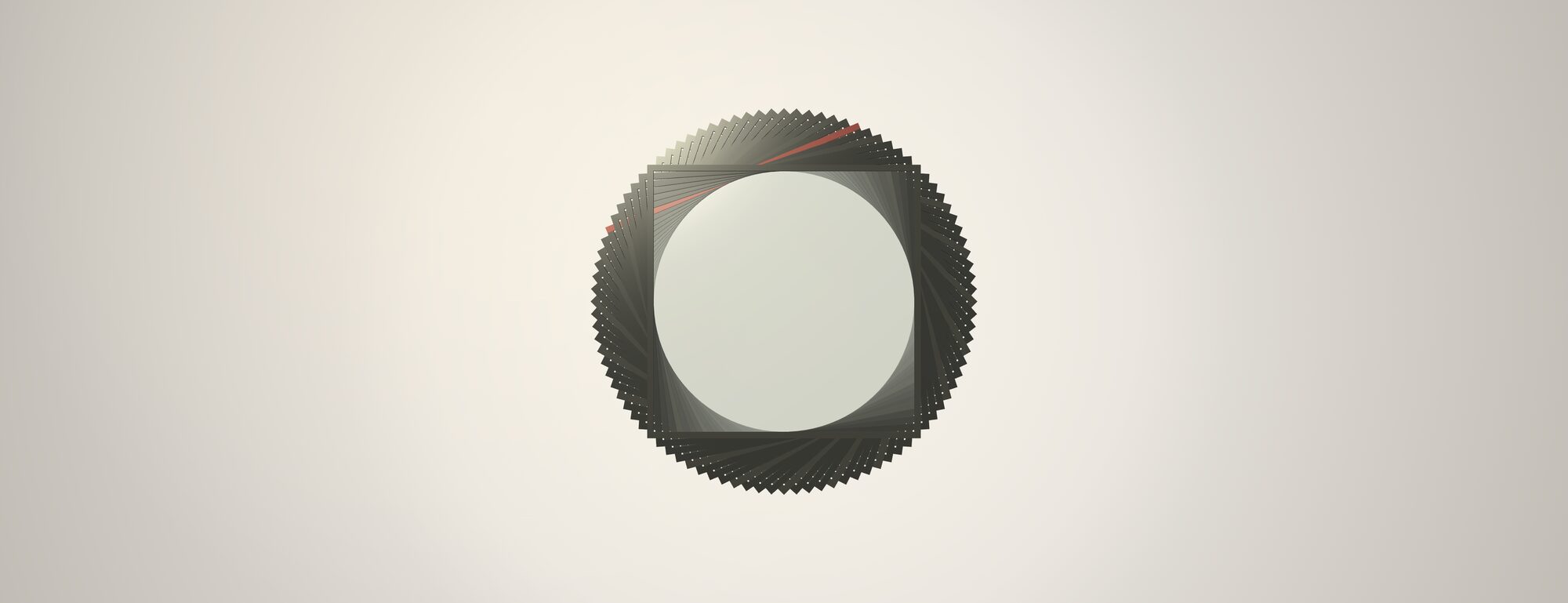
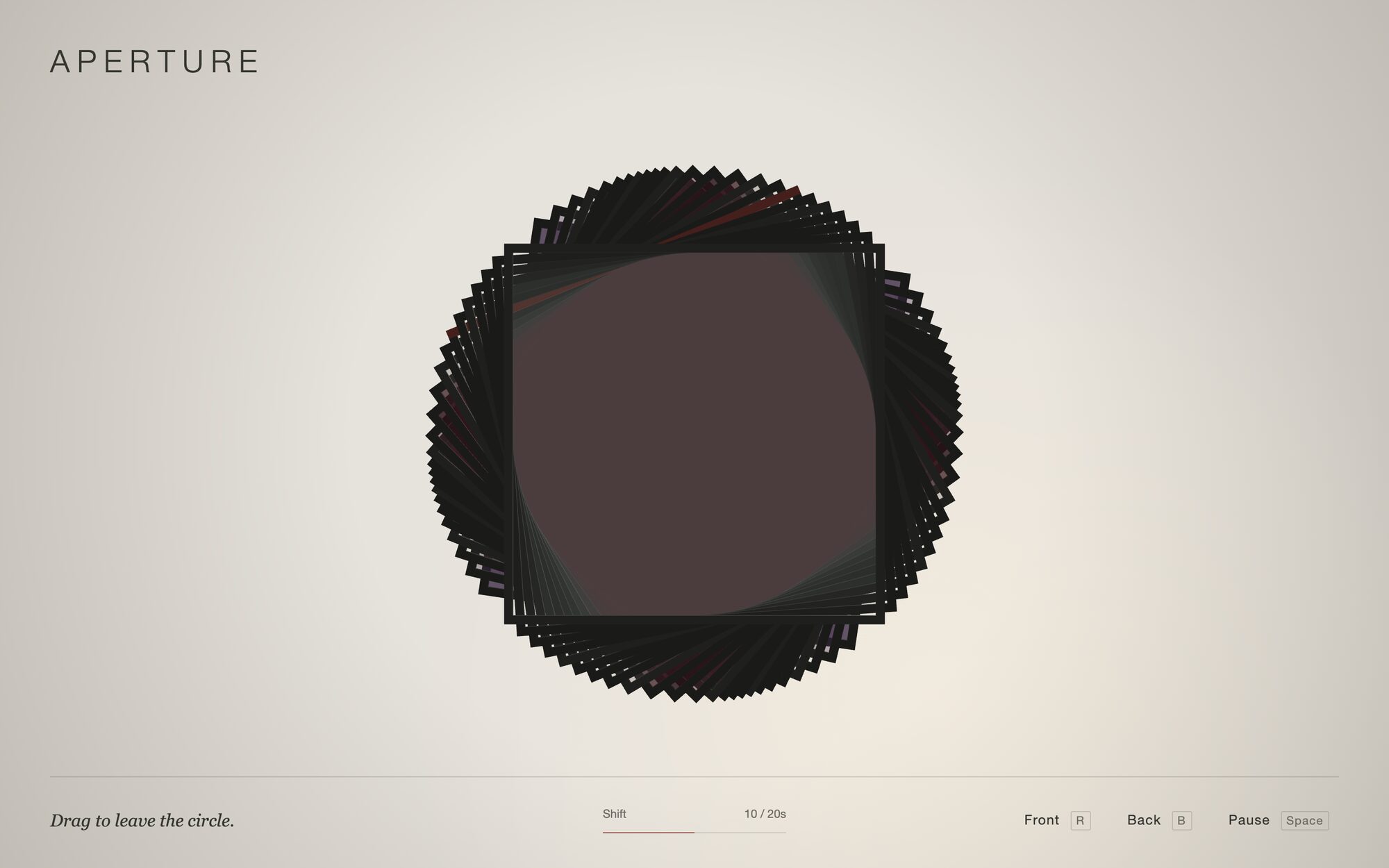
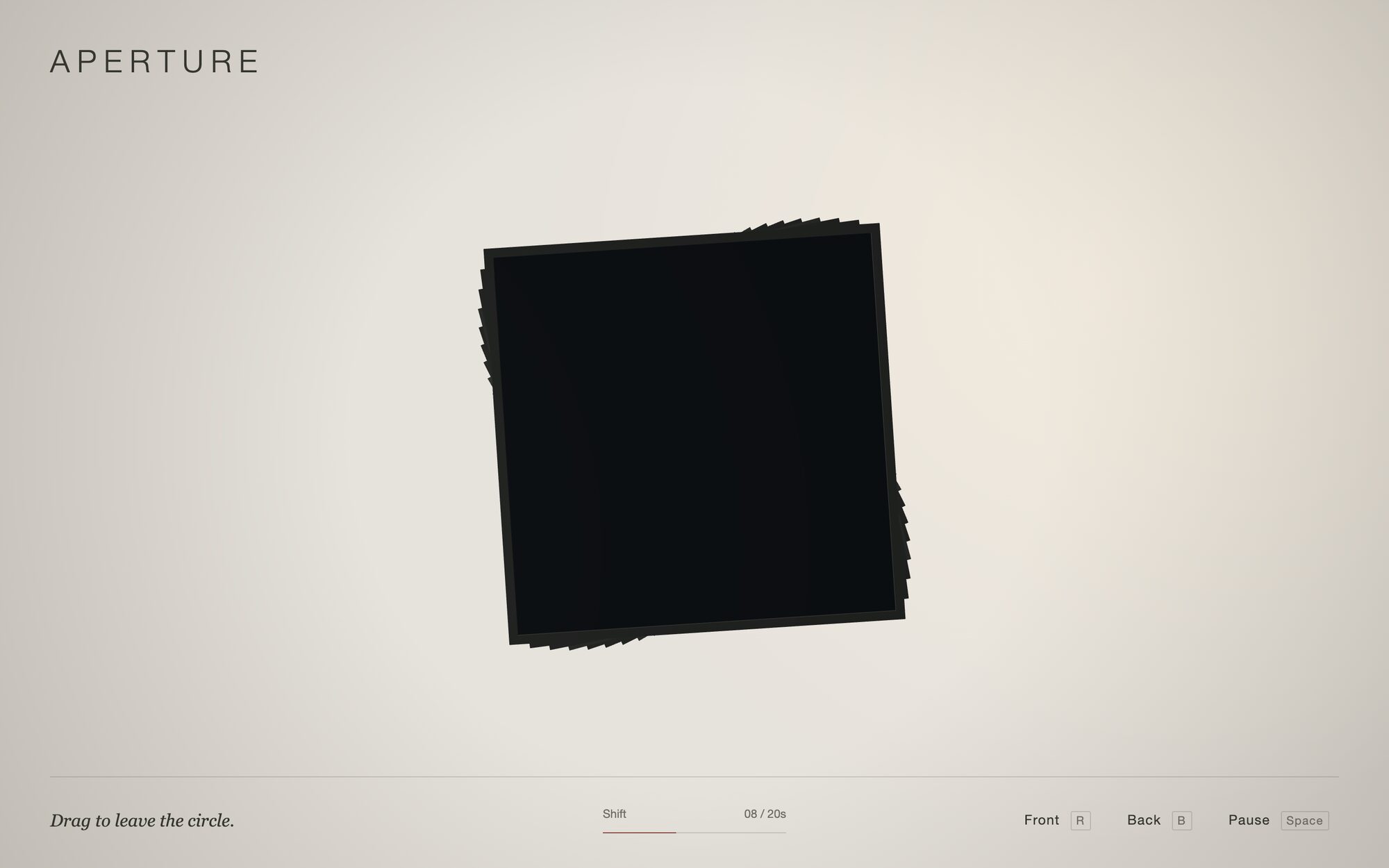
APERTURE is a stack of twenty-four square frames. Each one is turned a little more than the one in front of it, and from the front the twenty-four openings overlap into a round hole. There is no circle in the model. The circle is only the space the squares leave between them, and it exists from one place in the room.
APERTURE 是二十四个方框叠成的一摞。每一个框都比前面那个多转一点点,从正面看,二十四个方形开口叠出一个圆孔。 模型里没有圆。圆只是方框之间留出来的空隙,而且只在房间里的一个位置成立。
Live
Drag to orbit. R turns slowly back to the front, B turns to the back, Space pauses. Click the frame first so the keys reach it. Best on a desktop with WebGL.
拖动环绕观看。R 慢慢转回正面,B 转到背面,空格暂停。先点一下画面让按键生效。建议在桌面浏览器观看。
One cycle lasts twenty seconds: still, unfold, shift, return, rest. The aperture closes during the shift. Every fourth cycle it closes fully.
Overview
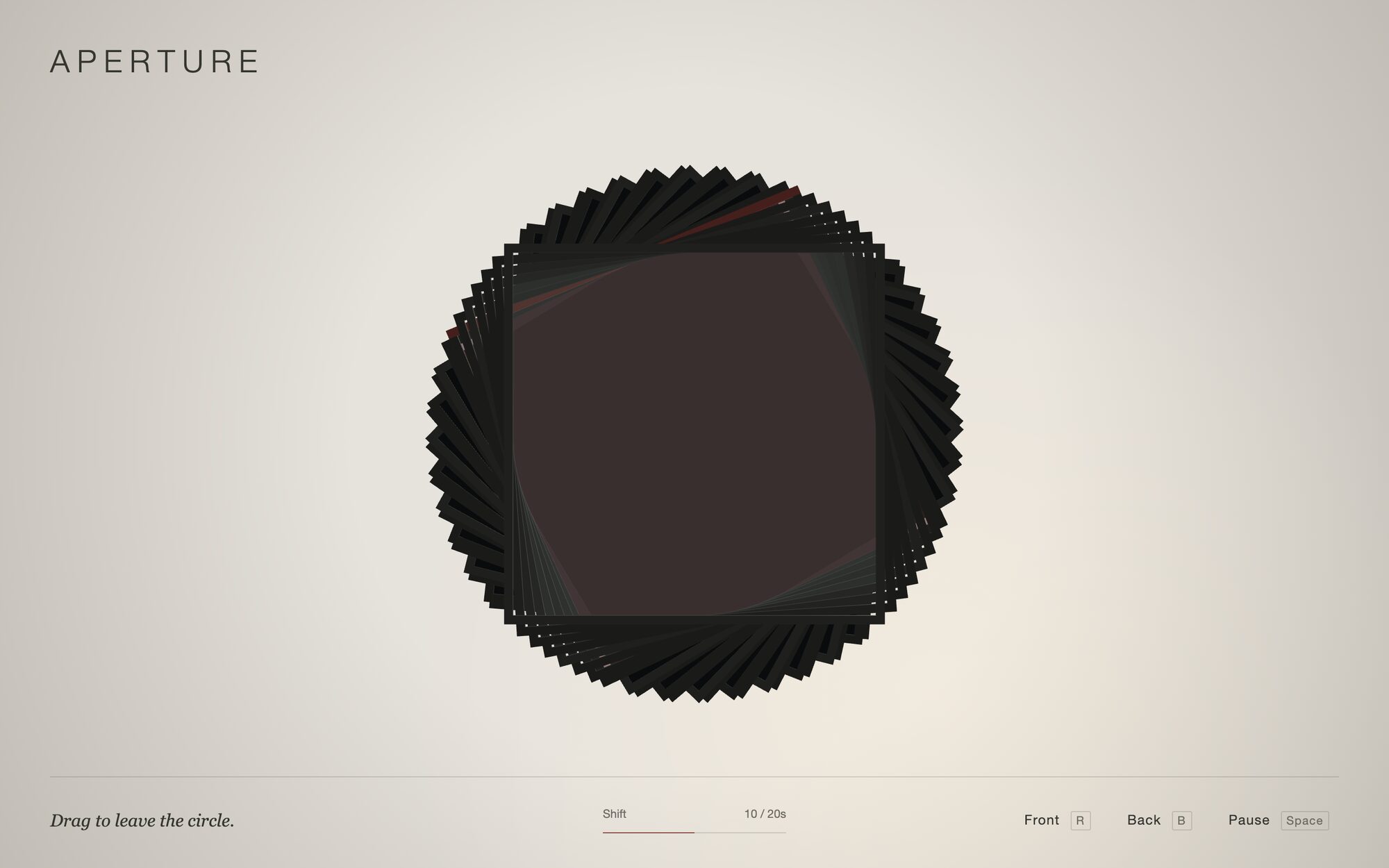
Each frame holds a thin pane of glass. The panes behave like polarizing filters. While the frames keep their order, light passes through the whole stack and the round window stays clear. Every twenty seconds the stack unfolds in depth, and then a wave of disorder runs into it from the frame with the red rail. When two adjacent frames deviate from their preset angles, the glass panels between them darken. The aperture closes, pauses briefly, and reopens once order is restored.
The light streaming in illuminated the wall behind. When the window was wide open, a soft halo shimmered around the circle of light; when the aperture closed, the halo vanished. A warm light circles the sculpture while it unfolds and returns, so the highlight travels round the rails and its glow moves over the wall.
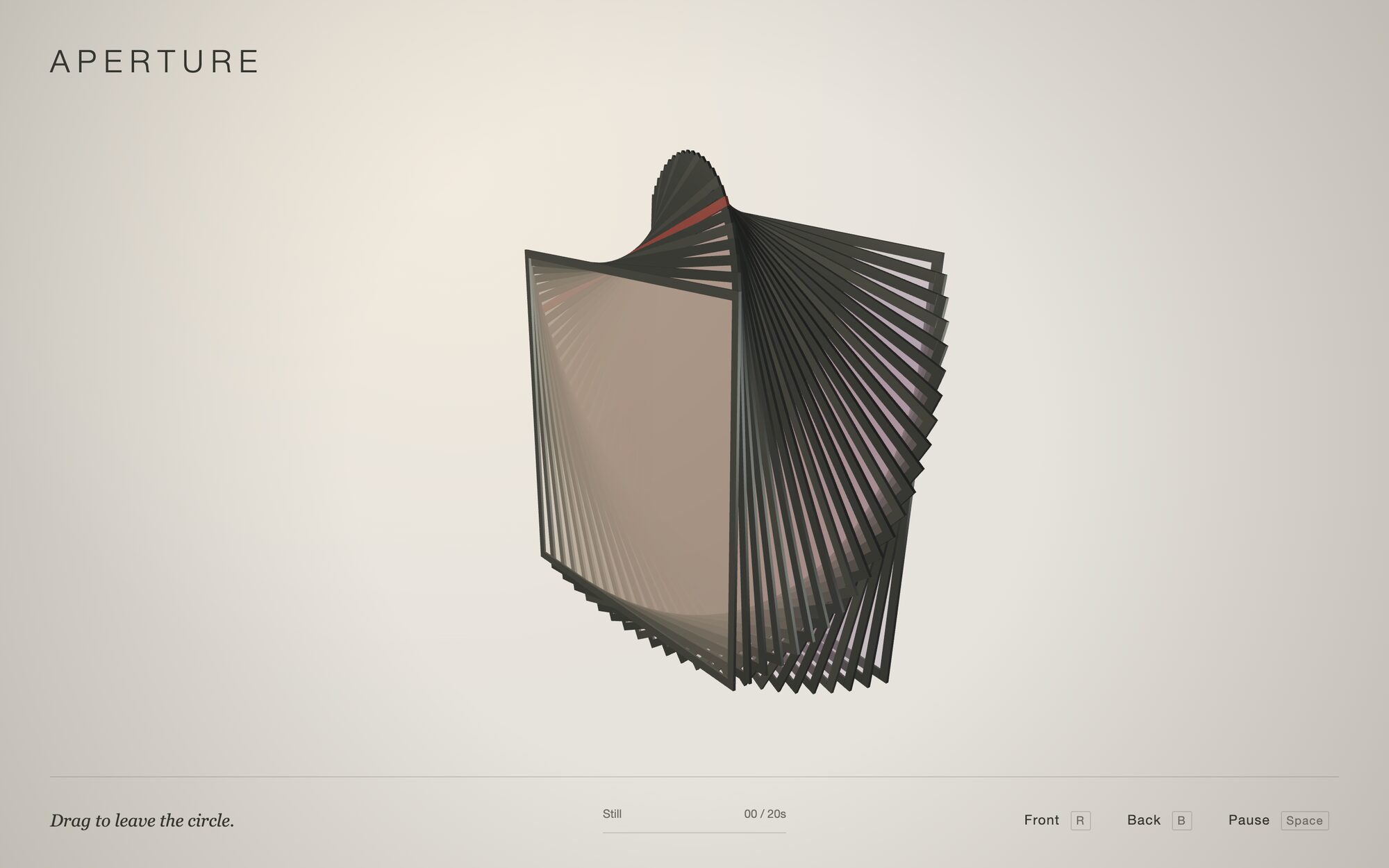
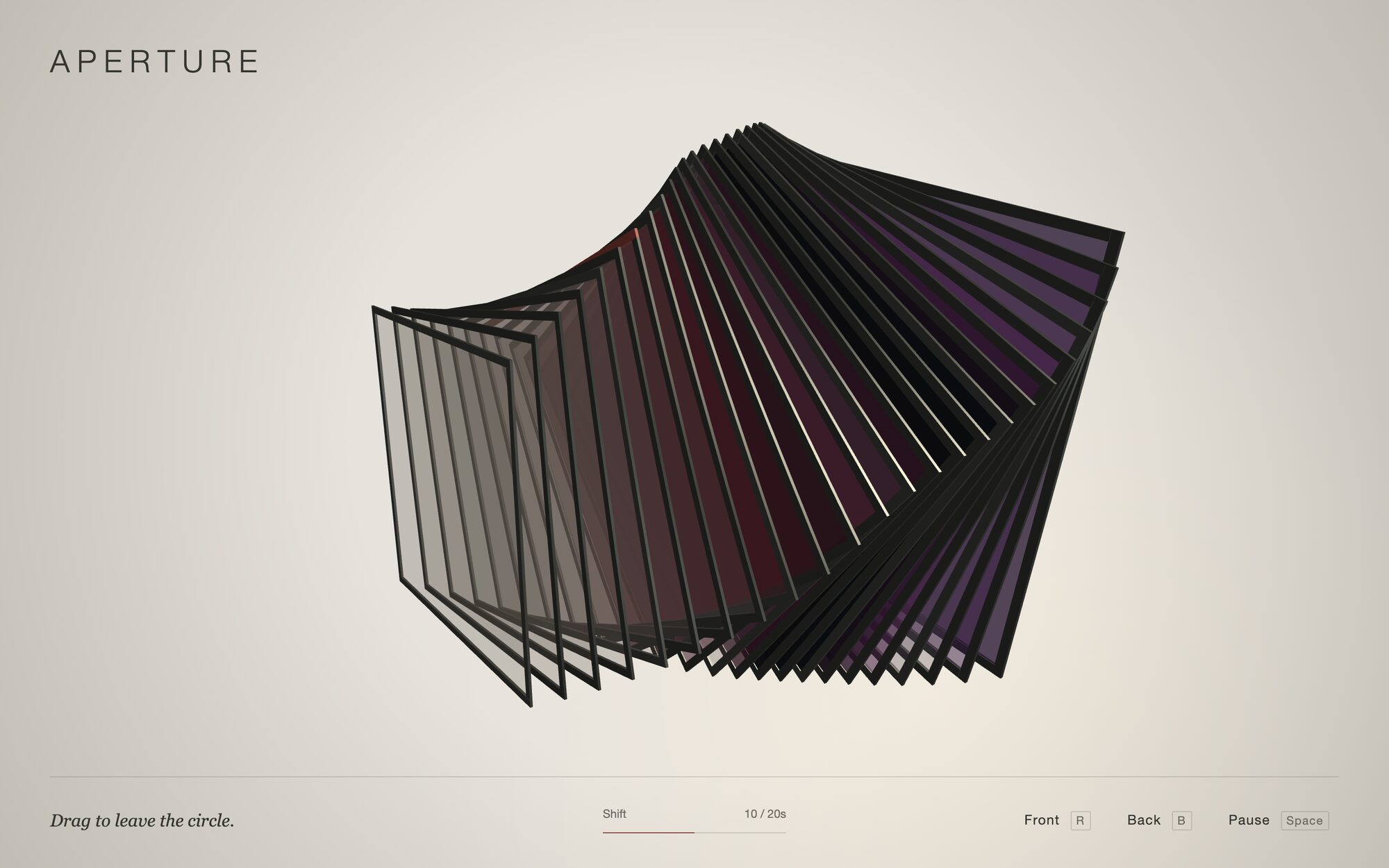
The viewer can walk around it. Drag the sculpture and the circle falls apart into a fan of turning frames. If you look away from the front, the glass will darken, because the light only comes through when you look straight on. Press R and the camera turns slowly back, and the window opens when it arrives. Press B and you see the back: from there, there is no circle at all, only a square.
The Front and the Side
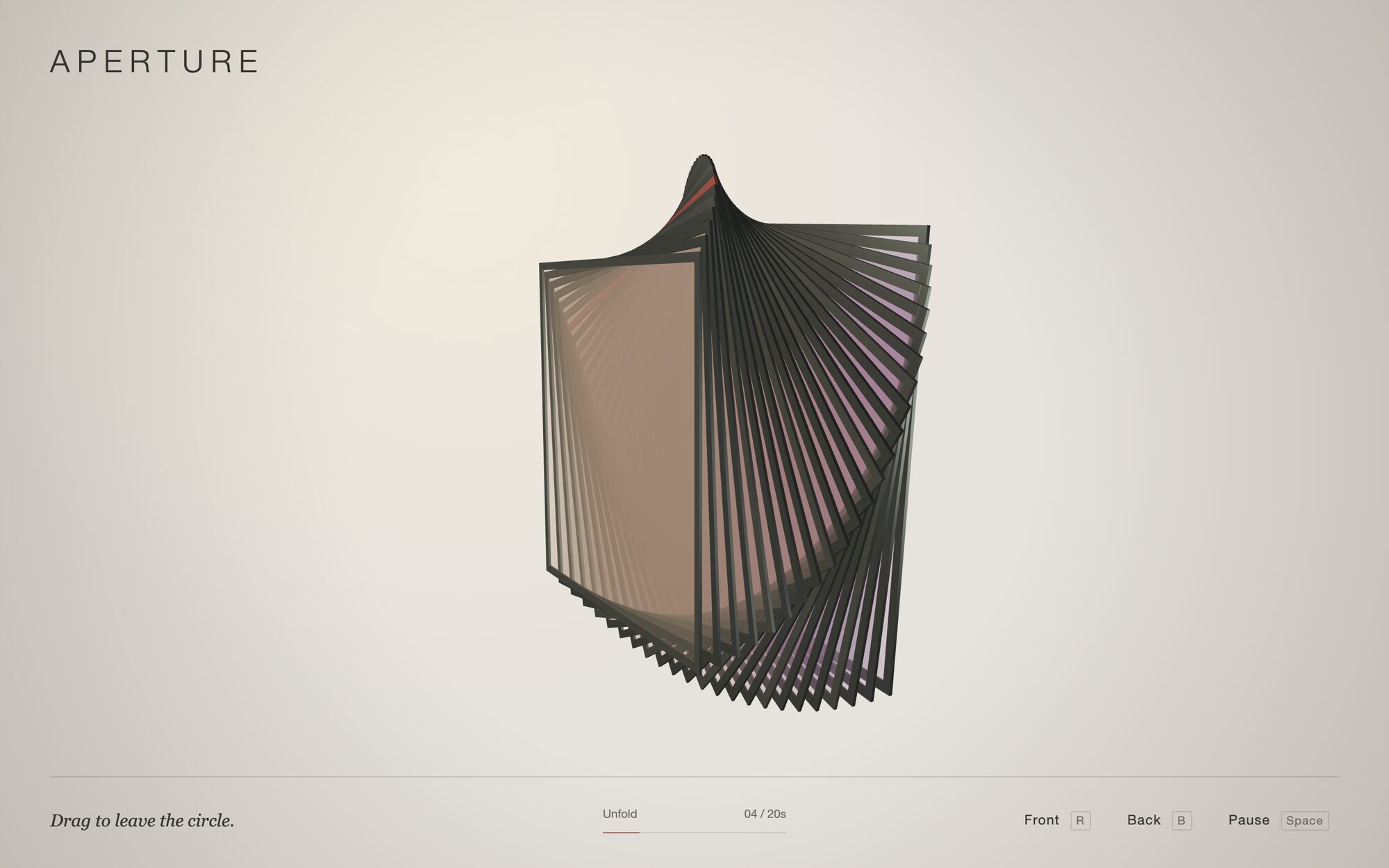
From the front, all twenty-four squares project to the same size, so the ring reads as one flat pattern. The frames sit eight units apart when compact and twenty-four when unfolded. The front image does not change while the stack unfolds: frames further back are scaled up by exactly the amount that perspective shrinks them.
The Aperture Closes
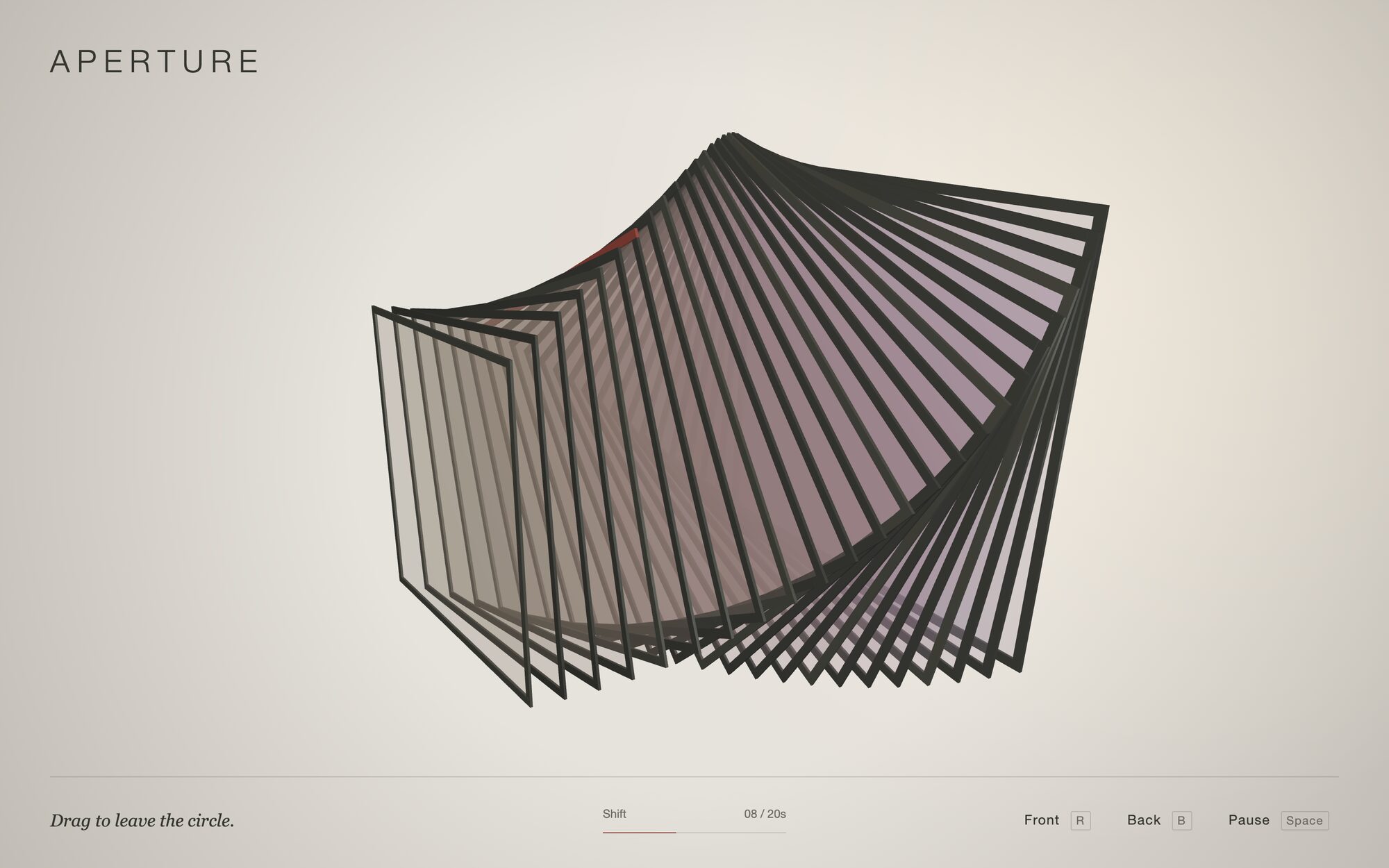
The shift is a wave that starts at the red frame and runs into the depth, so the frames in front keep the circle and what closes is round, not square. On its way to dark each pane passes through a tint, amber in front, red and magenta in the middle, violet at the back, like the colours a birefringent film shows between crossed polarizers. The pane in the red frame stays clear.
Looking Away
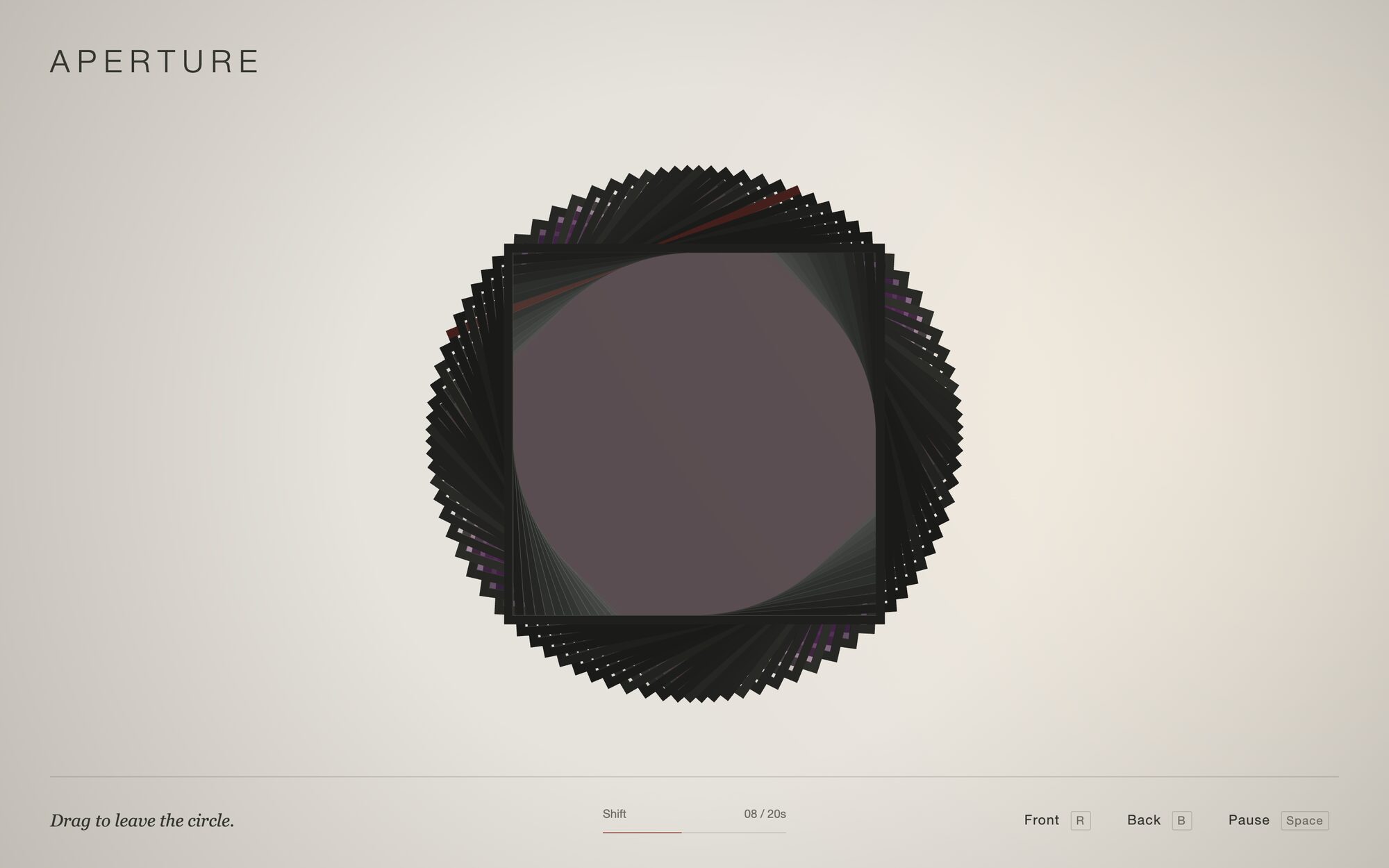
Looking away from the front adds a second term to the same rule, from the angle between the camera and the front. The glass darkens as you leave, and towards the back the camera steps back by itself, because the nearest frame is then the largest.
How It Is Built
I used BoxGeometry 120 times to build the structure. And a for-loop builds twenty-four groups, each with four rails and one pane, and sets their position, rotation and scale. The frames use MeshPhongMaterial with an ambient light, a warm key light and a cool fill light. The glass is the same material made transparent, with depth writing off so the twenty-four panes blend in order.
Scaling shapes the front view
A frame at depth z is scaled by (1000 - z) / 1000 in all three axes, so every point on it stays on the same line from the front camera. The stack can unfold and fold without the front image moving.
Malus's law
Light through two polarizers falls with the square of the cosine of the angle between their axes. The axes are parallel while the frames sit at their designed step, so only a deviation darkens a pane. The real deviations are about two degrees, so a sensitivity constant scales them until the largest reaches ninety. A model of the effect, not a simulation.
The wave
A sine wave starts at the red frame and travels into the depth, with an envelope that keeps the frames in front still. It slows for a beat while the aperture is closed and enters at a different phase each cycle. Every four cycles, it is replaced by a one-degree zigzag pattern, and the panels behind the red border also cross over one another.
The wall
The canvas is transparent and three soft gradients are behind it. And a halo with a brightness equal to the product of the light transmittances of the individual panels. The camera flights for R and B interpolate the orbit angles over the sphere.
Process
- Draw two sketches: a ring that only holds together from one viewpoint, and a tunnel of turning square frames. They became one idea, the circle as the gap between the squares.
- The first prototype had bare frames. The unfolding was checked by projecting every vertex from the front camera across four hundred poses; but I made a rounding error because of the largest drift.
- Subsequently, the railings were tapered, the lighting was softened, and the transitional forms were adjusted to smooth curves to ensure there were no abrupt changes in velocity or acceleration; one of the railings was painted red.
- The glass was first tried with a physical transmission material. It was heavy and the stacked panes did not build up. So plain transparent panes with depth writing off did what was needed.
- The polarizer rule with real angles showed nothing at first, since the steps pass more than ninety-nine percent of the light. A sensitivity constant made the effect visible and is documented as such.
- After these, I decided to implement a new perspective. When the wave passed through the frames nearest the viewer, the closed aperture read as a square slab. Starting the wave behind the red frame kept the circle round while it closed.
- Actually,the first tints ran through green in the middle of the stack and fought the palette. The sequence now runs amber, red, magenta, violet, and sits with the red rail.
- The last rounds fixed the camera staying far away after a drag round the back, added the circling key light, the full close on the fourth cycle and the lit wall.
Reflections
The strongest moves were subtractions: keeping the front frames still, letting one pane stay clear, starting from one red line. A physical rule turned out to be a good design tool even when it had to be exaggerated to be seen, because it kept every pane consistent with its neighbours.
In general, I found I'm recently very intersted in the way a physical rule can be used to design a virtual sculpture. And try to simulate this characteristic with physics and maths in coding environment.