BP Boyan PengThreshold Garden · HCI case study
Threshold Garden · HCI case study Cooperative mathematical installation

A two-player game for learning linear algebra

Threshold Garden

The math between two hands.

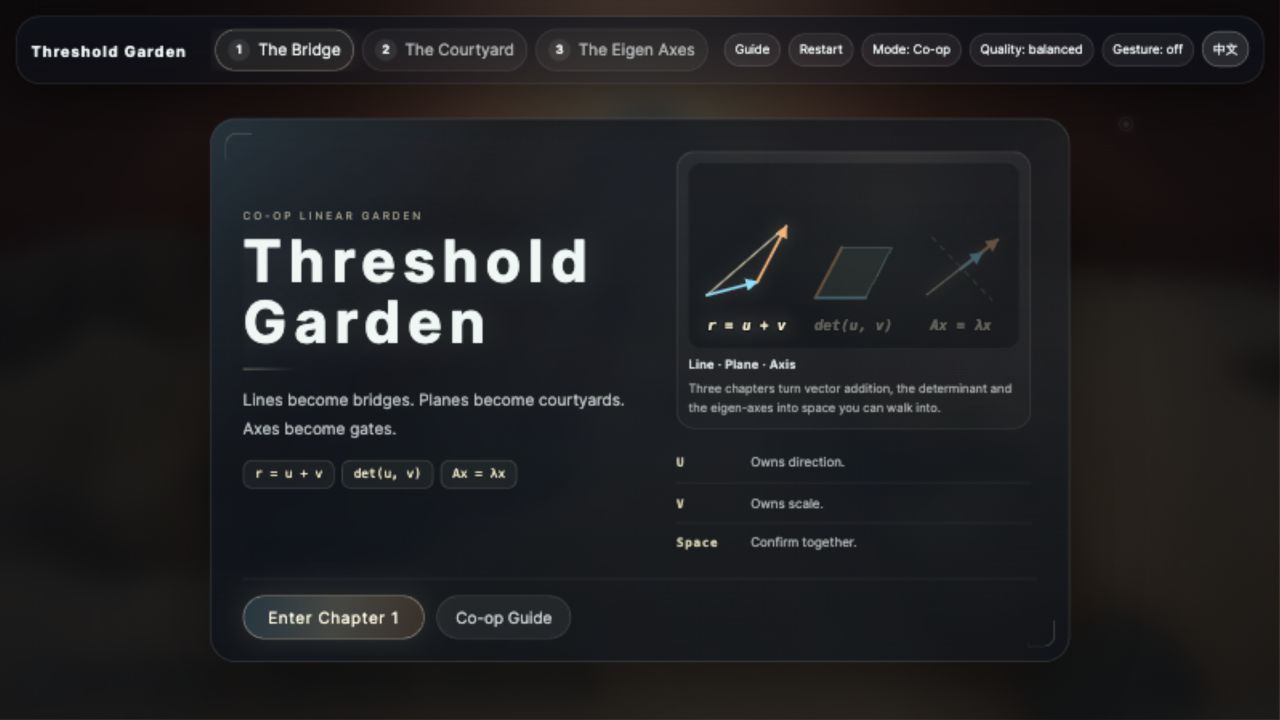
A two-player WebGL game that turns linear combination, the determinant, and eigenvectors into three connected garden chambers — one continuous world, crossed from dusk to moonlit night.

01 · liner = u + vaddition becomes arrival
02 · planedet(u, v)determinant becomes area
03 · axisAx = λxeigenvectors become resonance

RoleIndependent design & development

FocusLearning design · CSCL · interaction

StackThree.js · WebAudio · shaders · MediaPipe

StatusPlayable prototype · external study planned

01 · Background — why a garden

Linear algebra is usually a solitary screen task — vectors are symbols on a flat plane, rotated and scaled in silence.

In plain terms

Two players share control of one vector: one sets its length, the other its angle. Neither can solve a puzzle alone — so they have to talk, negotiate, and move together. The math is learned through the body and through conversation, not memorized symbols.

I care most about learners with dyscalculia or spatial anxiety, for whom the silent, symbol-heavy screen is a threshold they can't cross alone. I built the design on four ideas taken from the research:

Positive interdependenceCSCL

Success is shared. Length and angle are split across two people, so no one can opt out.

Shared attentionTUI

One screen, not two. Both players look at the same garden, so language does the work.

Asymmetric cooperationGAME

Unequal control forces negotiation — each player has to teach the other what their half does.

Embodied cognitionHCI

The hand remembers what the eye forgets. Rotation becomes a movement, not a rule.

CSCL Computer-Supported Collaborative Learning TUI Tangible User Interface HCI Human–Computer Interaction

The core mechanic · three steps

STEP 01
Player A · LengthKeys WS

Pushes or pulls to set how long the vector is.

STEP 02
Player B · AngleKeys AD

Rotates to set which way the vector points.

STEP 03
Together · The goalTalk & align

Neither lands the tip alone. They talk it onto the target.

Collaboration measurably helps math · effect sizes (Cohen's d)

Group task performanceChen et al. · 2018 · N = 425
0.89
Cooperative math, G10–11Ridwan et al. · 2022
0.87
Skill acquisitionChen et al. · 2018
0.64
CSCL achievementMeta-analysis · 2021 · N = 3,474
0.52

How to read it — these are effect sizes (Cohen's d); anything above 0.8 is a large effect. Collaborative math learning clears that bar repeatedly — the case for building this was empirical, not just aesthetic.

From evidence to design — the throughline

EvidenceCollaboration lifts outcomes across 400+ studies (ES 0.4–0.9).
Decision. Co-op is the default mode, not a bonus level.
EvidenceAsymmetric "public-goods" games provoke the deepest strategy talk (game theory).
Decision. Split one vector — A owns length, B owns angle. Neither can solo it.
Evidence"Accountable talk" beats IRE call-and-response (TalkMoves, 567 transcripts).
Decision. On-screen prompts nudge players to explain each move to their partner.
EvidenceTangible, embodied input scaffolds dyscalculic learners (TUI / embodied cognition).
Decision. Direct-drag handles now; Arduino knobs next — never bare sliders.
Bottom line

The research is clear that collaboration helps math. Threshold Garden is my attempt to make that collaboration physical — to put the math in the space between two hands.

Selected sources — Chen, Wang, Kirschner & Tsai (2018), Review of Educational Research · Ridwan et al. (2022) · Suresh et al. (2021), the TalkMoves corpus · 2021 CSCL meta-analysis (N = 3,474). Full bibliography available on request.

02 · Discovery — listening first

User interviews

What I asked: where exactly does linear algebra stop making sense — and who is with you when it does?

Format

Semi-structured · 45–60 min

Synthesis

Affinity mapping · 142 coded notes

Setting

In school · familiar classroom

Ethics

Guardian consent · anonymized

8

semi-structured interviews
45–60 min each

4

learners, G10–11
2 with dyscalculia

2

math teachers
35–48 per class

2

educational
game designers

Affinity themes · N = 8 · mentions

"I remember by doing, not by reading"kinesthetic preference across both learner groups
7/8
"Symbols feel arbitrary"det, λ, basis — names without bodies
6/8
Fear of being slow in front of othersstrongest in dyscalculic learners
5/8
Working in pairs lowers the stakes"if we're both confused, it's the problem's fault"
5/8
"GeoGebra feels like a tool, not a place"existing software lacks atmosphere & ritual
4/8
"I can rotate it in my hands. I cannot rotate it in my head."P3 · learner, dyscalculia · on mental rotation tasks
"When the whole class is silent, asking 'why' feels like confessing."P6 · learner, G11 · on classroom dynamics
"I don't need them to compute faster. I need them to stop being afraid of the grid."P7 · teacher, 12 yrs · on what success looks like

Personas · behavioral extremes from the interview data

Xiaoyu · the silent visualizer

16 · G11 · dyscalculia · likes ceramics & rhythm games

"I know the answer is a place, not a number. I just can't find the road."

Goals
  • Pass linear algebra without memorizing recipes
  • Understand why det can be negative
  • Never be the slowest visible person in the room
Frustrations
  • Numbers swap places when she holds 2+ variables
  • Mouse + slider UIs punish shaky precision
  • Help always arrives as more symbols
symbols
shapes & spacestrongly spatial
reading
touching & doingstrongly hands-on
alone
with a partnerclearly with others
What this means for the design — she enters through the hands and needs a partner to share the load. A symbol-first, solo, precision-heavy screen loses her on contact.
Mr. Chen · the stretched teacher

38 · teaches 3 classes of 40+ · 15 min prep per lesson

"I have one body and forty pairs of eyes. The tool has to do the noticing for me."

Goals
  • An activity that runs itself for 20 minutes
  • Visible evidence of who is stuck where
  • Concepts that survive until the exam
Frustrations
  • Lab software needs 10 min of setup he doesn't have
  • Pair work collapses into one student driving
  • "Fun" tools that quietly drop the math
lecture
facilitateleans facilitate
skeptical
eagercautiously open
What this means for the design — he'll adopt a tool that facilitates and shows him who is stuck — but only if it runs itself with near-zero setup and never quietly drops the math.

Tool landscape · positioning

COLLABORATIVE SOLITARY SYMBOLIC EMBODIED Textbook Khan Academy GeoGebra 3Blue1Brown Desmos VMT · chat + whiteboard Class pair work Threshold Garden
FIG · the open quadrant — precise tools were solitary (GeoGebra, Desmos); social tools stayed symbolic (VMT, pair worksheets). The collaborative-and-embodied quadrant was nearly empty. That gap became my thesis.

Classroom observation · 3 sessions · 120 min

OB · 01

One mouse, one driver

In shared-laptop pair work, the stronger student held the mouse 83% of observed time. The partner's role decayed to witness.

OB · 02

Gesture precedes language

Students traced vectors in the air seconds before they could verbalize them — hands consistently ahead of words.

OB · 03

Errors hide indoors

Mistakes on private screens stayed private; the same error on the projector sparked group debugging within seconds.

"Hands were always ahead of words, and words ahead of symbols. So I gave the game one job: let a learner enter at the hand and exit at the symbol."Field synthesis · design implication
Target · 01

Physical input that forgives imprecision

Coarse, damped controls — shaky hands land on the same math as steady ones.

Target · 02

Forced — but warm — interdependence

Neither role is optional; neither role is the smart one. Space is a shared ritual.

Target · 03

Math state visible to a third pair of eyes

A teacher reads who is stuck where from across the room, without interrupting.

03 · Concept & world — one garden, three hours of light

Core concept

One matrix.
Three identities.
One day in the garden.

I gave each identity of a matrix its own garden: lines become bridges, areas become courtyards, axes become gates.

Each chapter translates a mathematical property into a spatial verb. The camera moves continuously from dusk to daylight to moonlit night; the world never cuts away.

OPENING CH.1 · UNION BRIDGE Linear combination · dusk r = u + v BRIDGE → WATER COURT continuous handoff CH.2 · MEASURING COURT Determinant as area · day det(u,v) = uₓv_y − u_yvₓ AXIS CORRIDOR camera travels, fog lifts CH.3 · RESONANCE AXIS Eigen axis · moonlit night Ax = λx ENDING KNOWLEDGE CHAIN REVEALED ONE CONTINUOUS 3D GARDEN · NO SCENE CUTS · PROGRESS SURVIVES REFRESH

Art direction · 3 chapters = 3 hours of light · art is the pedagogy

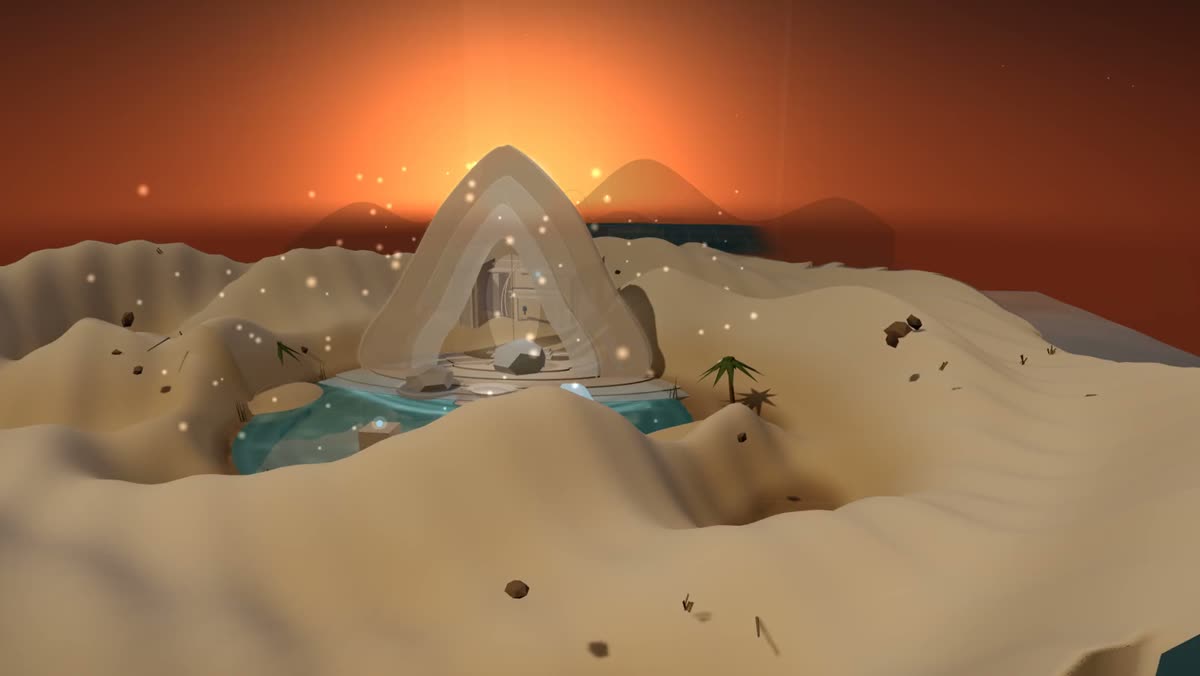
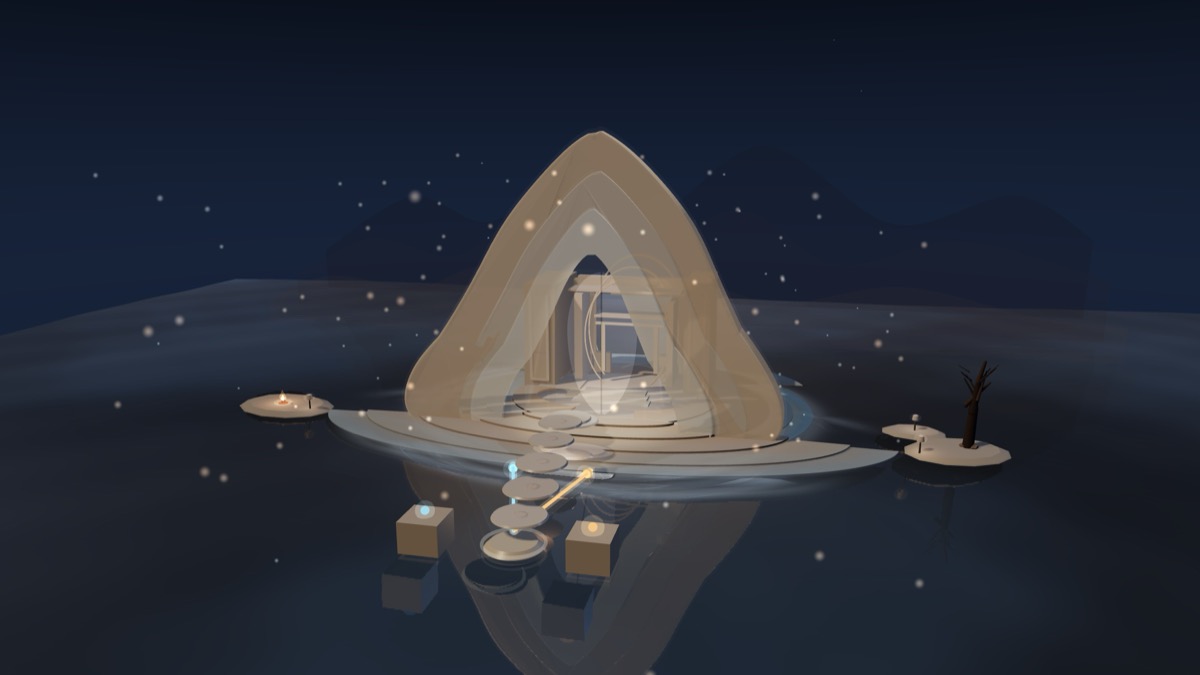
UI-free render of the Union Bridge chapter at dusk
Dusk

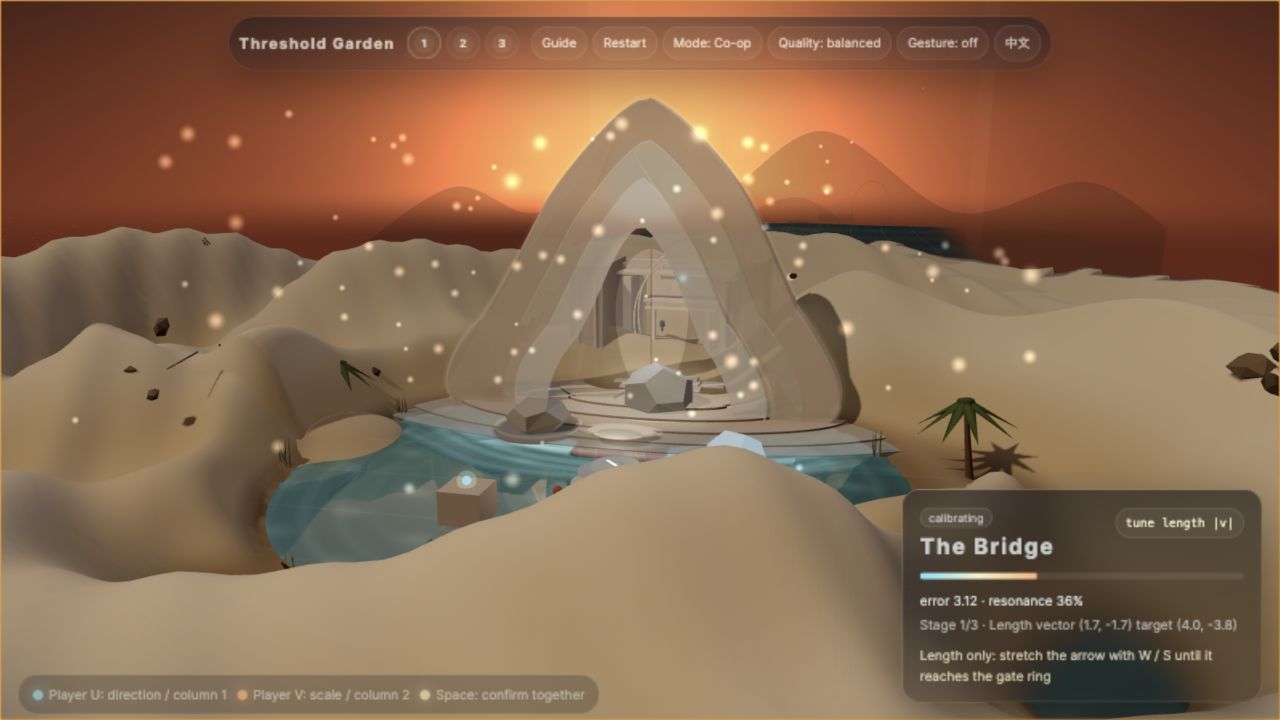
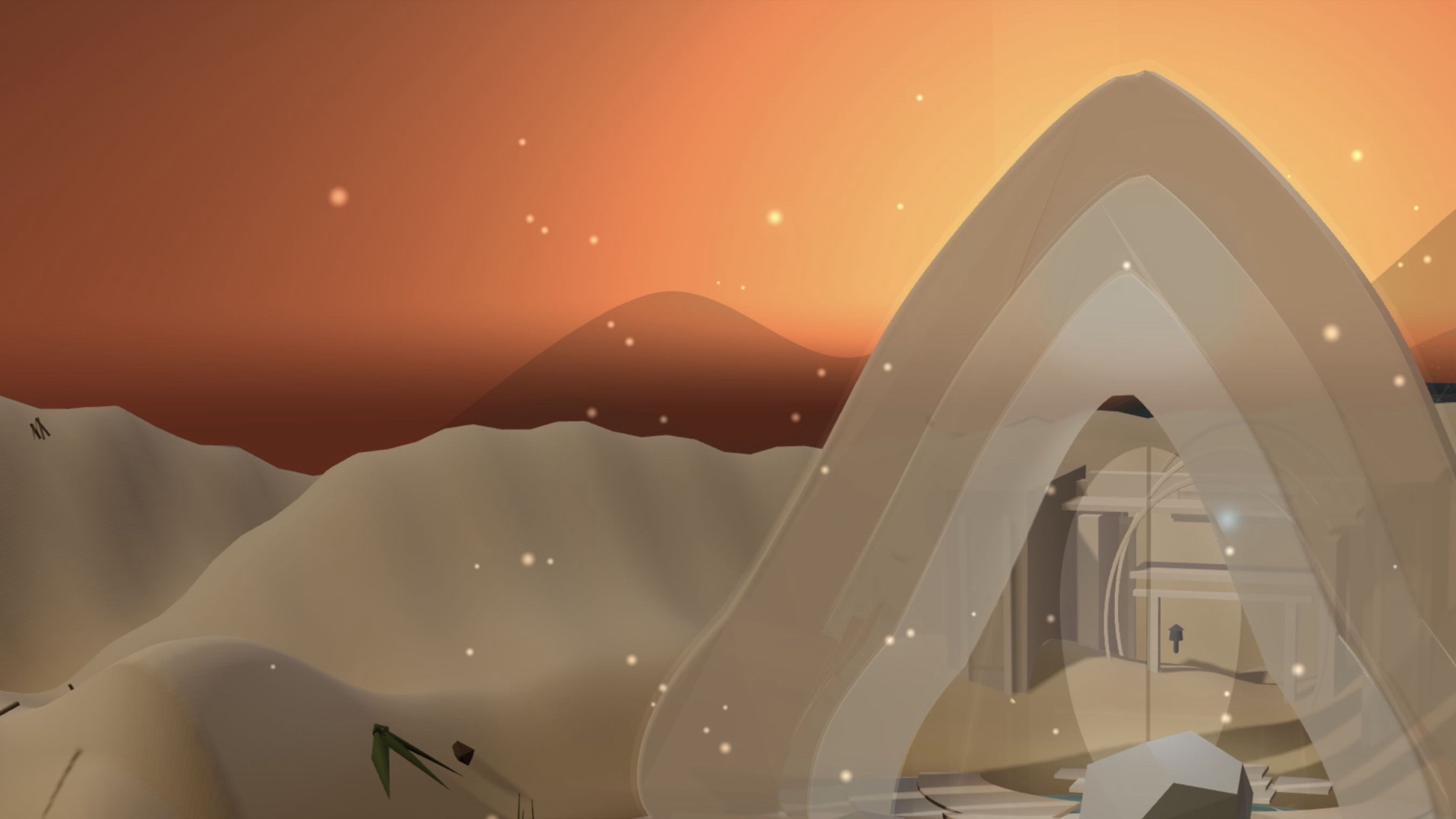
Desert oasis · Union Bridge

CH.1 · LINEAR COMBINATION

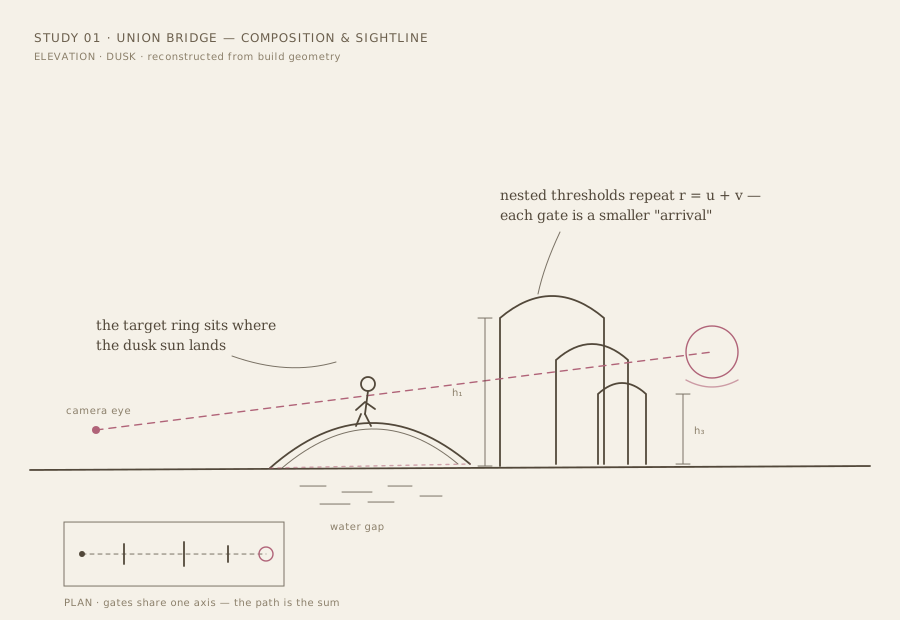
Nested thresholds repeat vector composition in architecture; the traveler crosses only after r reaches the gate. Dusk makes addition a journey.

terracotta · sand · turquoise
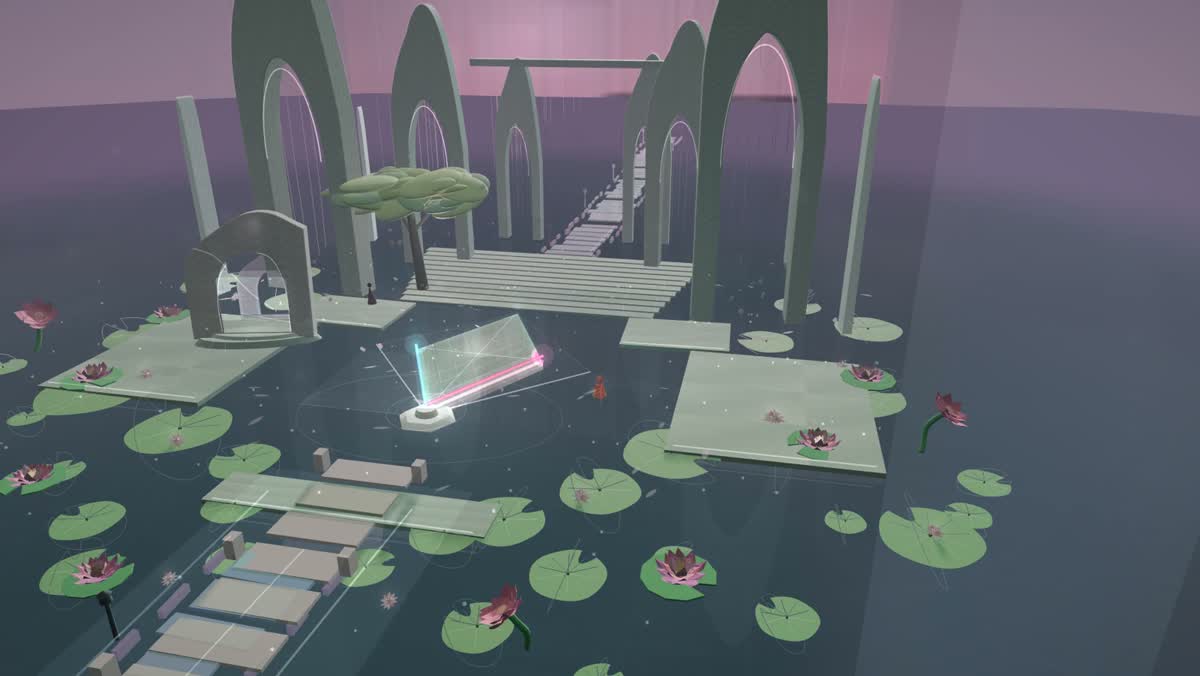
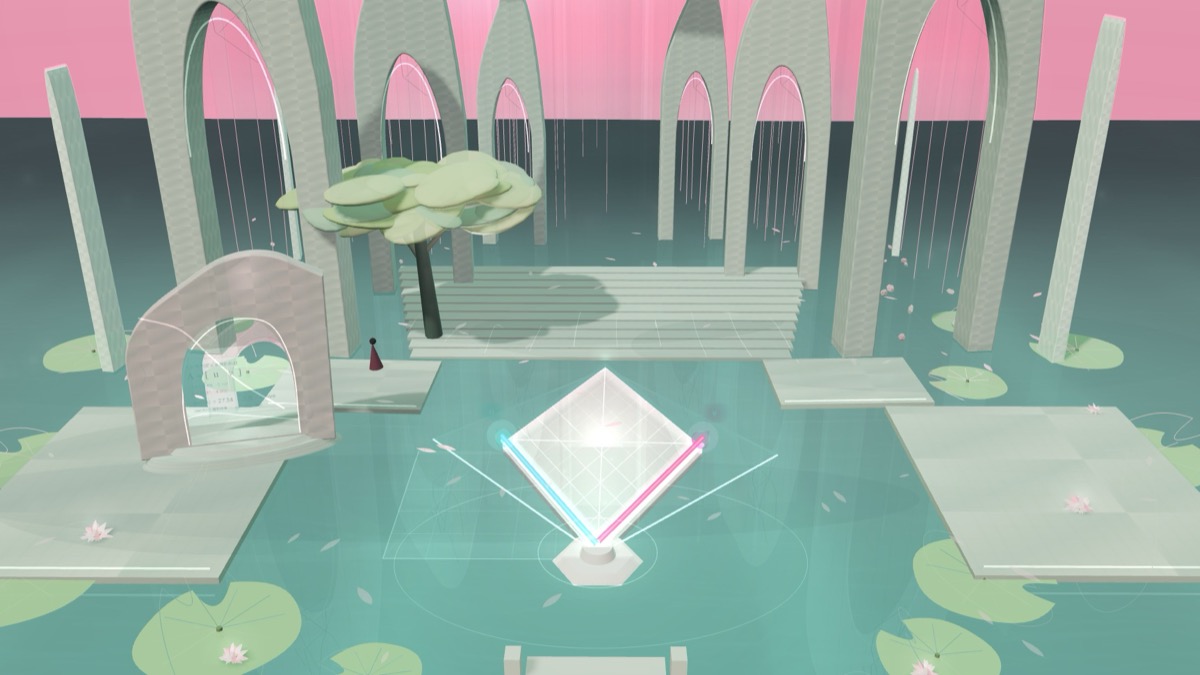
UI-free render of the Measuring Court chapter in daylight, positive determinant
Daylight

Lotus court · Measuring Court

CH.2 · DETERMINANT AS AREA

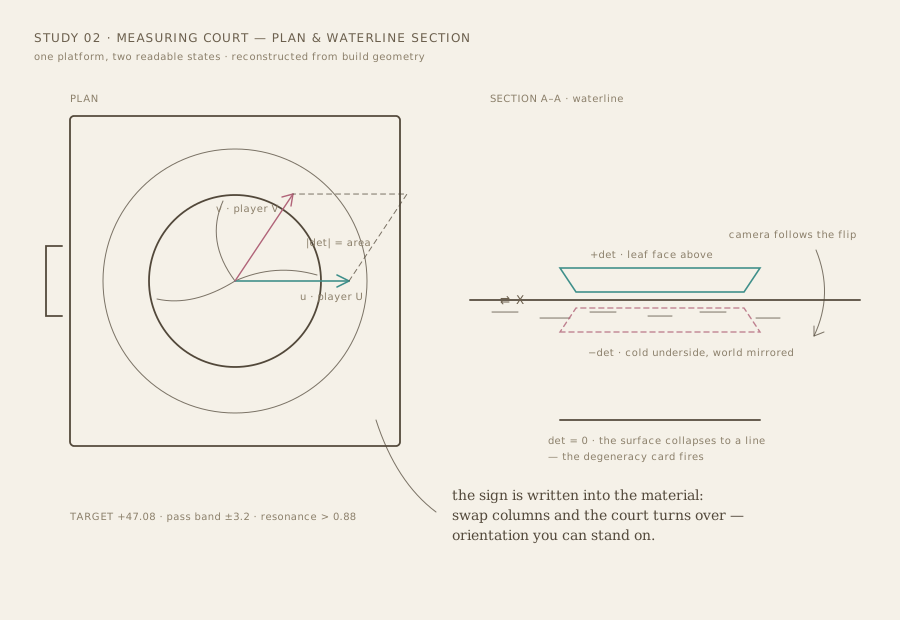
Positive area is a green lotus leaf; swap the columns and the court turns to its cold-blue underside — the sign is written into the material. Near collinearity, the platform collapses into a line.

lotus pink · mint · leaf green
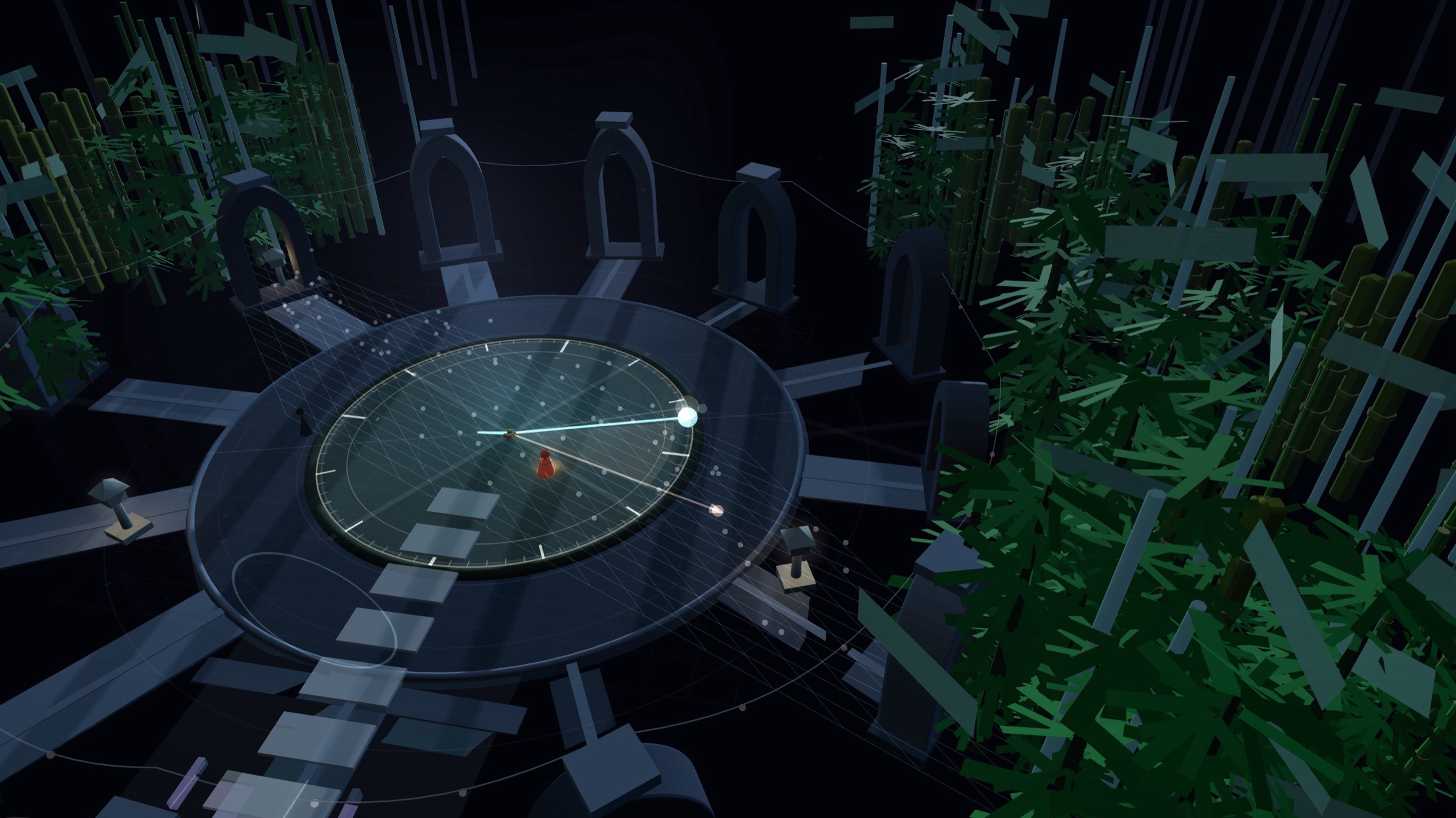
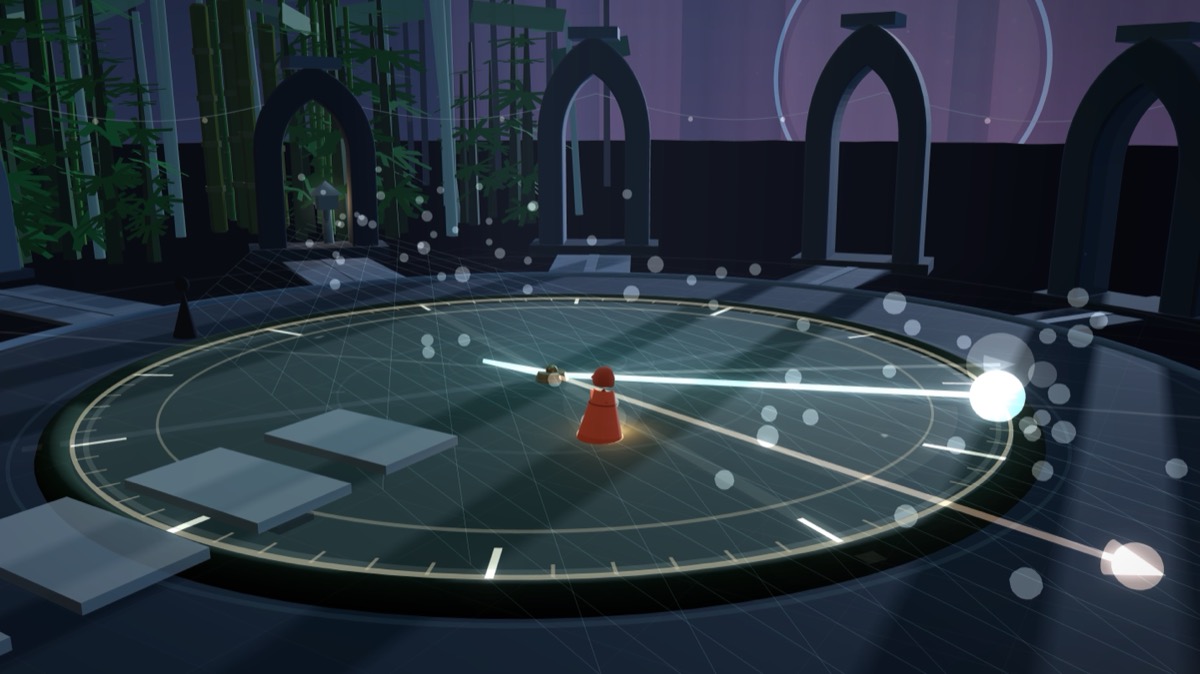
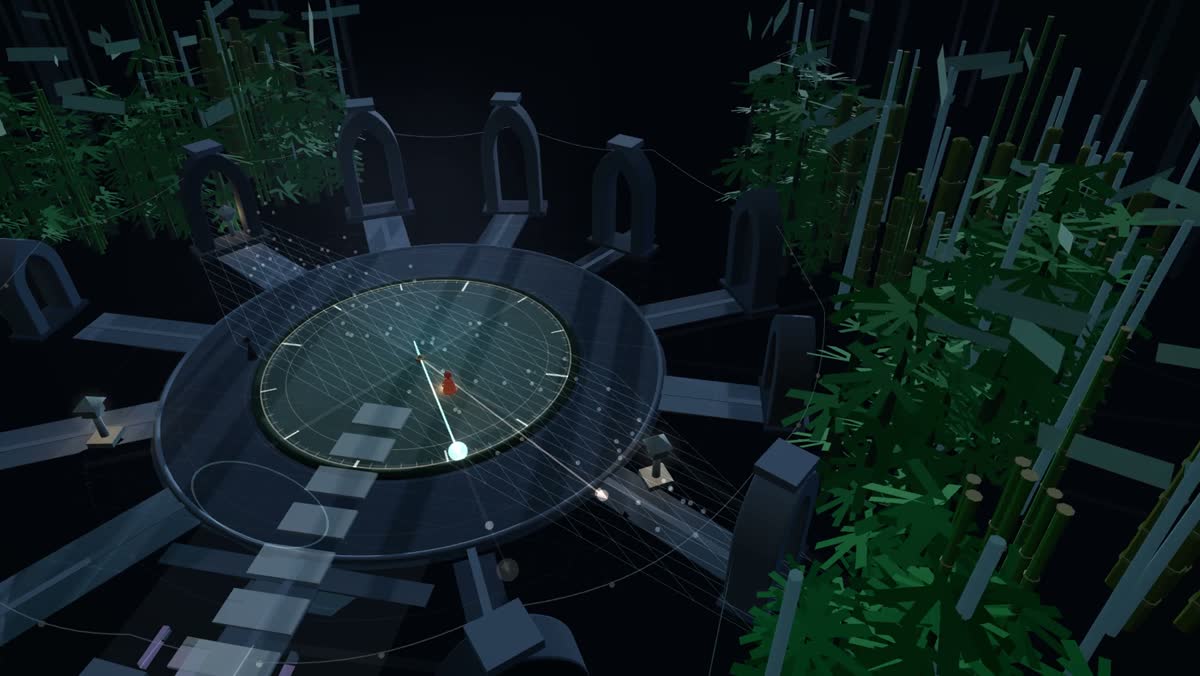
UI-free render of the Resonance Axis chapter, the complete moon-dial court at night
Moonlit night

Bamboo night · Resonance Axis

CH.3 · EIGEN AXIS

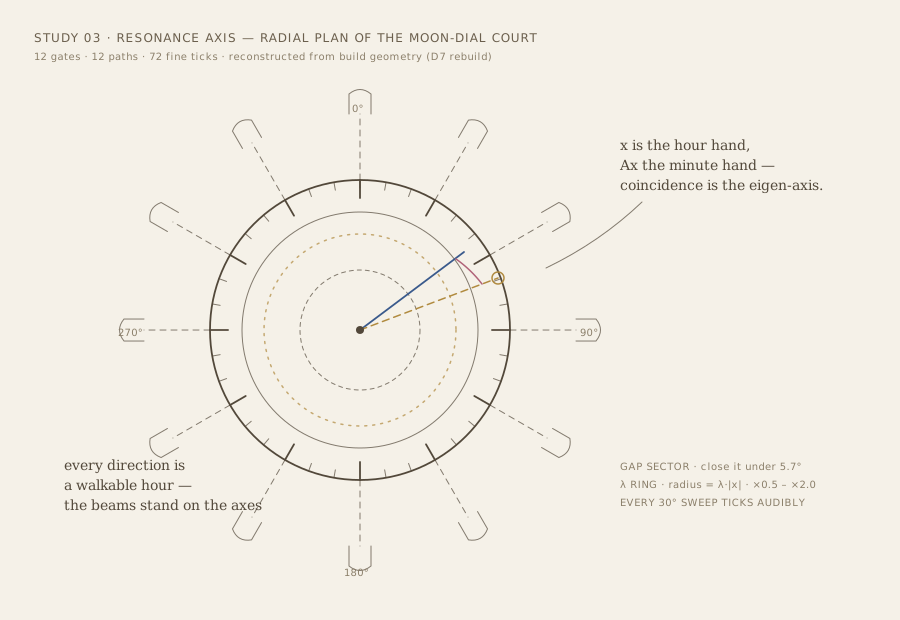
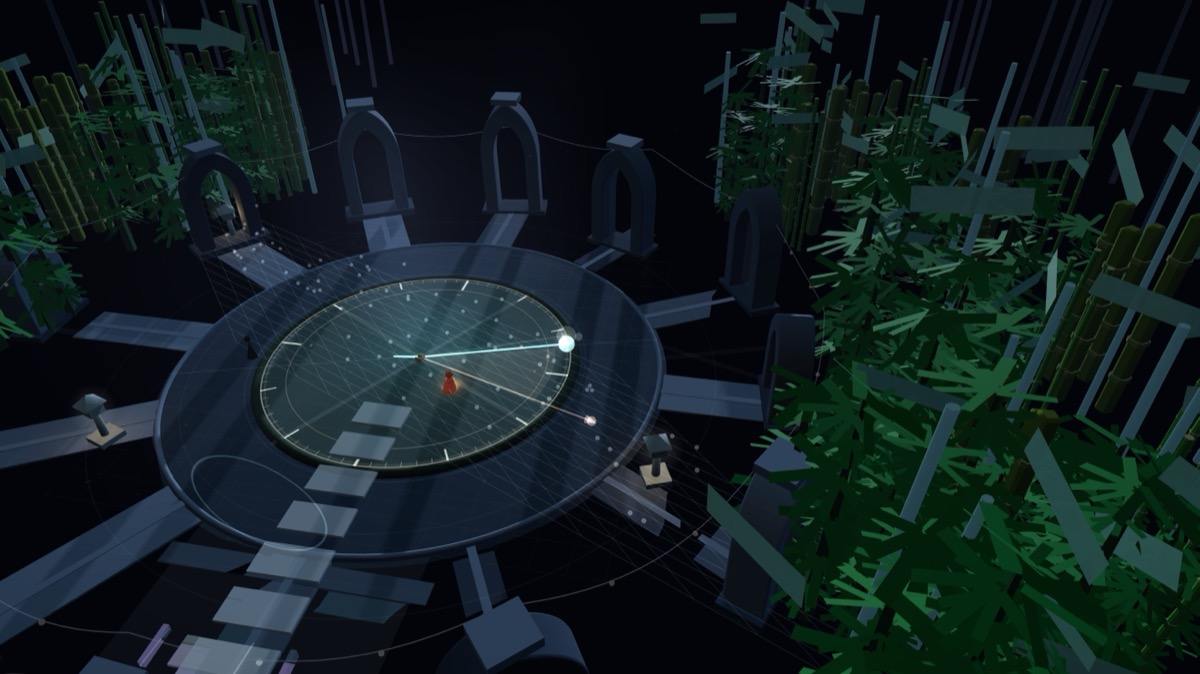
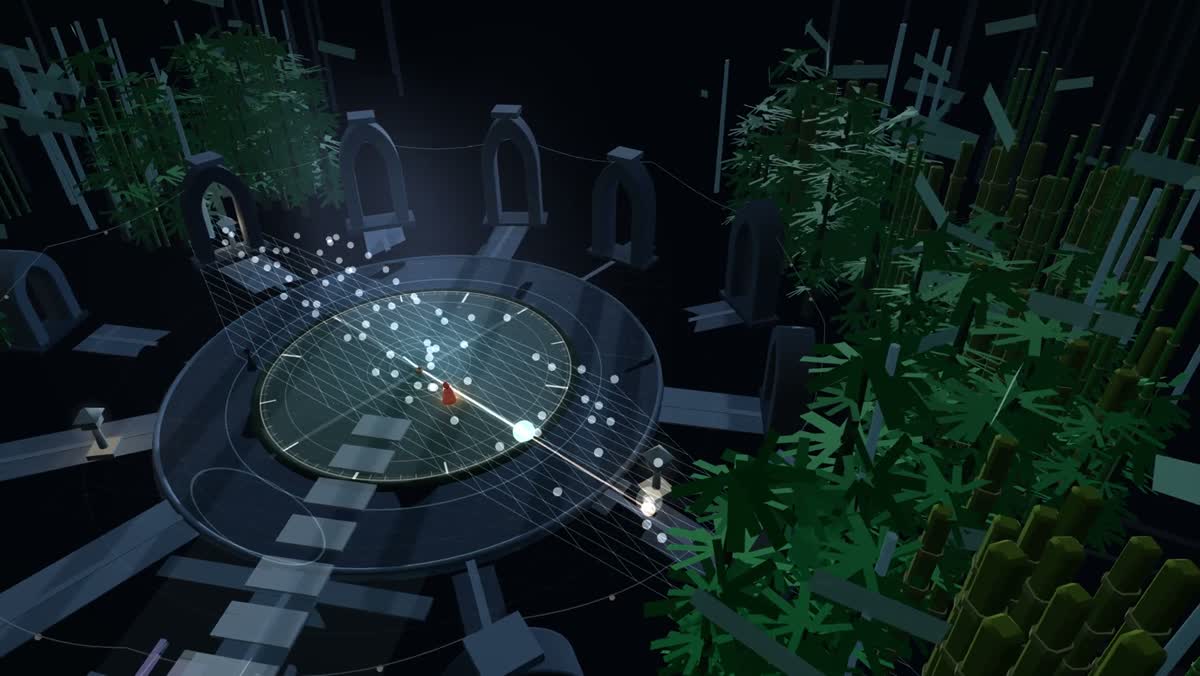
Twelve gates and twelve paths radiate from a moon dial: x turns like a clock hand and Ax chases it. The moonbeam curtains are the theoretical eigen-axes — the math glows before it is named.

indigo · moon white · amber

Scene design studies · reconstructed from the build's geometry

Line-art composition study of the Union Bridge scene with sightline notes
STUDY 01 — bridge composition: nested gates on one sightline; the target ring sits where the dusk sun lands.
Line-art plan and waterline section study of the Measuring Court
STUDY 02 — court plan & waterline section: one platform, two readable states — leaf face above, cold underside below.
Line-art radial plan study of the moon-dial court with twelve gates and twelve paths
STUDY 03 — moon-dial radial plan: 12 gates · 12 paths · 72 fine ticks; every direction is a walkable hour.
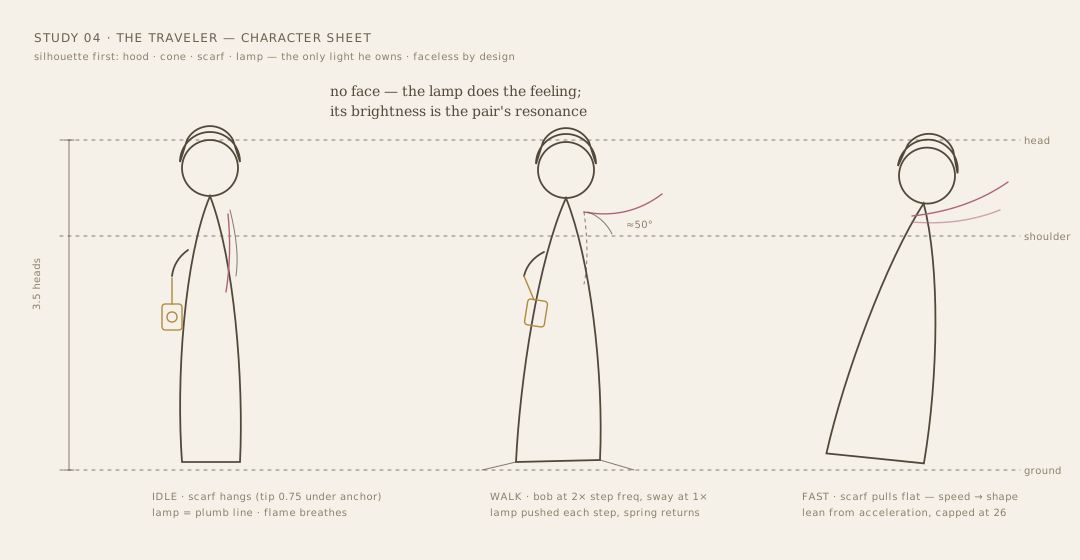
Line-art character study sheet of the traveler: silhouette, proportions, scarf and lamp states
STUDY 04 — character sheet: silhouette first — hood, cone, scarf; the lamp is the only light he owns. Idle hang · walk swing ≈ 50° · run streamline.

Design studies (reconstructed) — drawn from the shipped scene geometry to document composition intent; not scanned originals.

04 · Character & modeling — a witness, not an avatar

The traveler · 《送灯》 Carrying the Lamp

Not an avatar.
A consequence.

The faceless figure carries a lamp through the garden, and the lamp's brightness is the resonance — how close the pair's math is to the threshold. He waits until a valid mathematical path exists, then walks it. Correctness becomes an event someone can witness.

U direction / column 1 V scale / column 2 SPACE shared confirmation

Modeling diagram · one character, three channels

01 · POSTURE / GAIT speed inferred from position deltas; bob at 2× step frequency, sway at 1×, slope pitch on ramps. No animation clips. 02 · SCARF / CLOTH verlet chain: physics owns gravity, wind and the big swing; traveling ripples are pure geometry — impulses never enter the solver (idle jitter ÷ 39). 03 · LAMP / PENDULUM one damped pendulum fed by gait bob, weight shift and acceleration; flame brightness = live resonance value. one shared wind field — bamboo, scarf, grass read the same gust
FIG · the traveler is a layered controller, not a rig: posture, cloth and lamp read the same walk but never feed each other impulses.

Model plates · wireframe → clay → lit

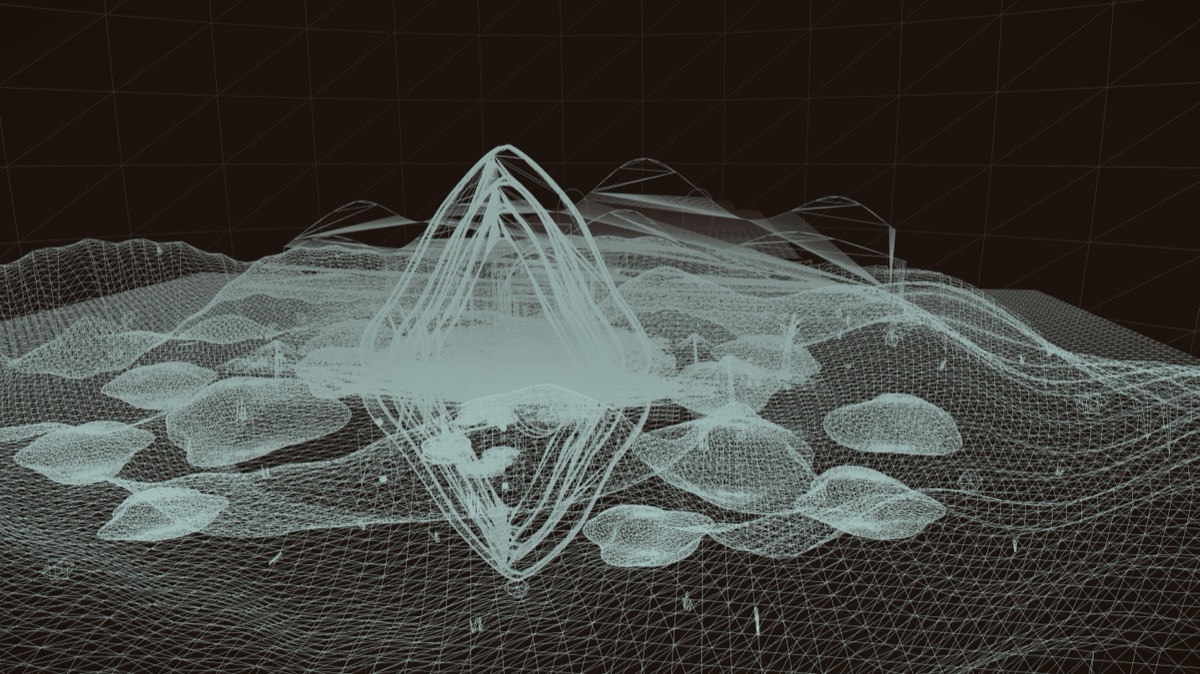
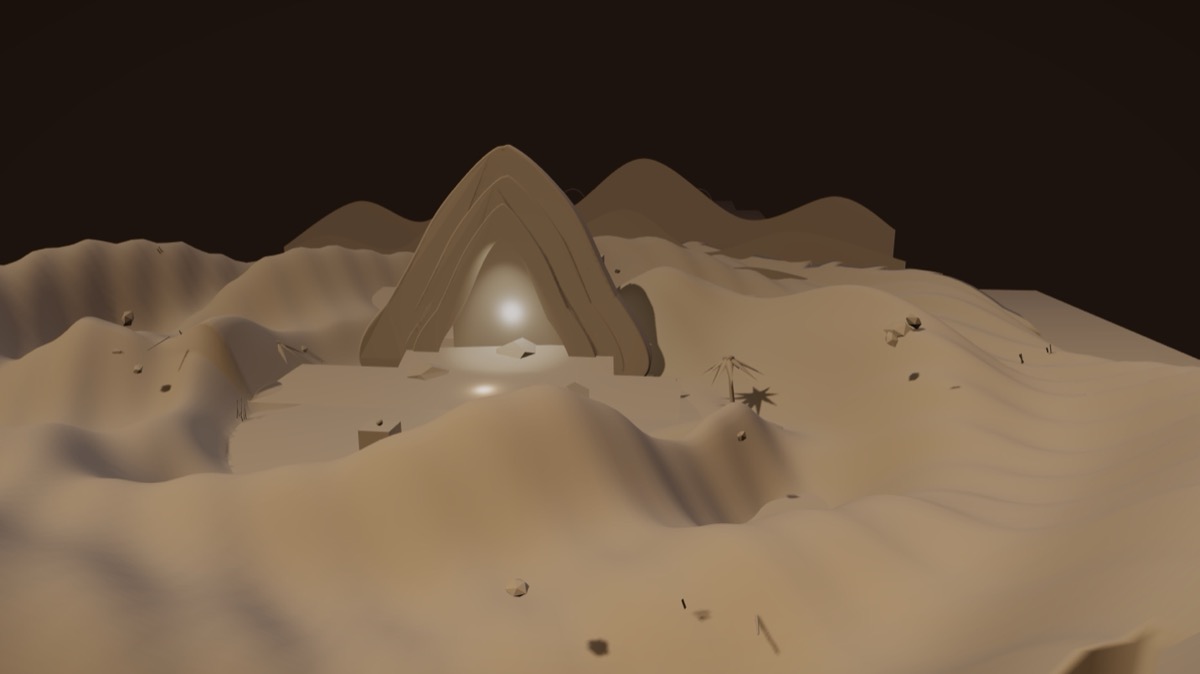
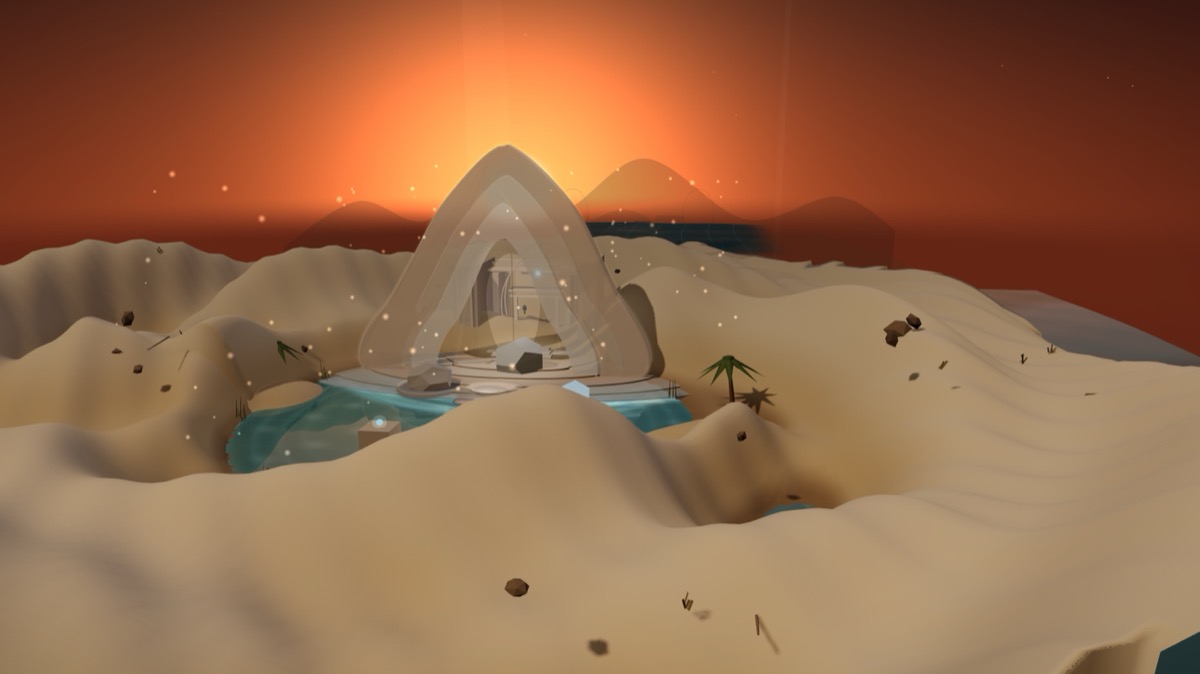
11 low-poly models auditioned · 5 kept · 745 KB total · CC0 / CC-BY · everything else procedural

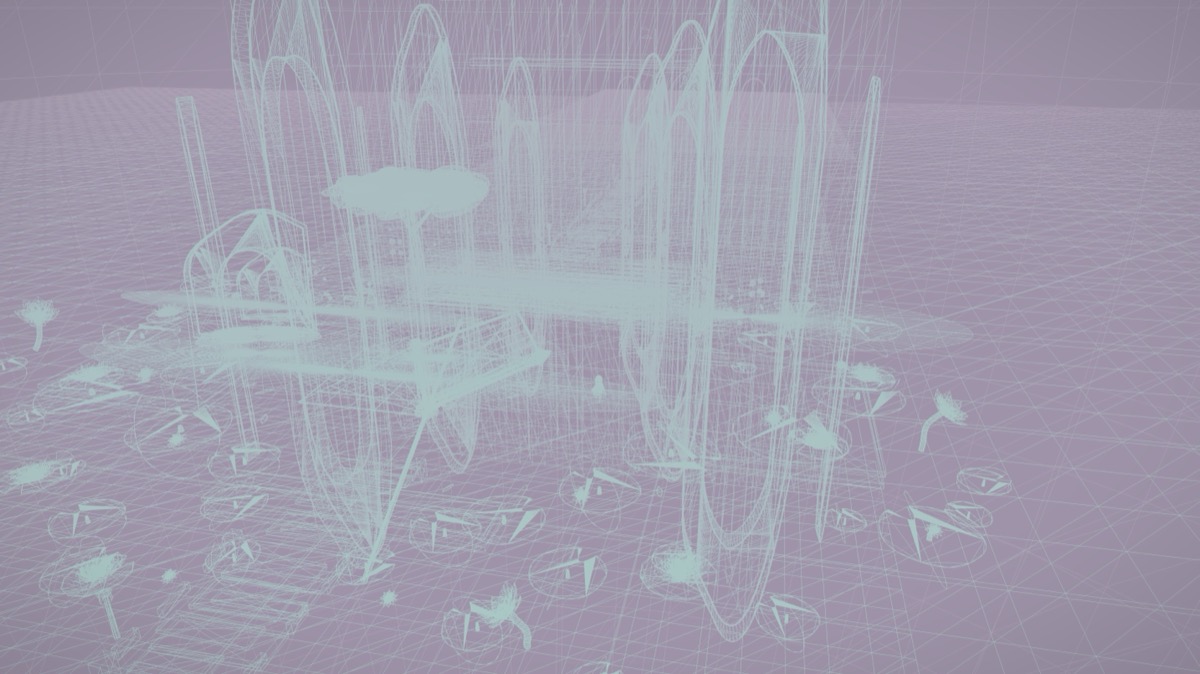
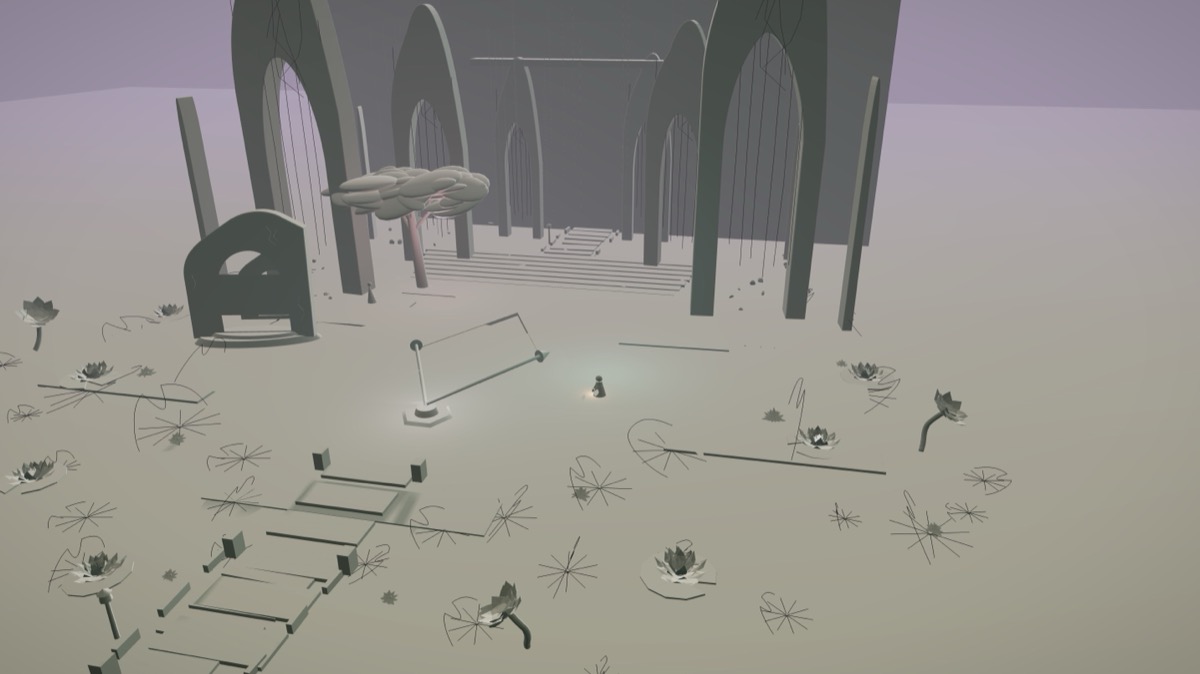
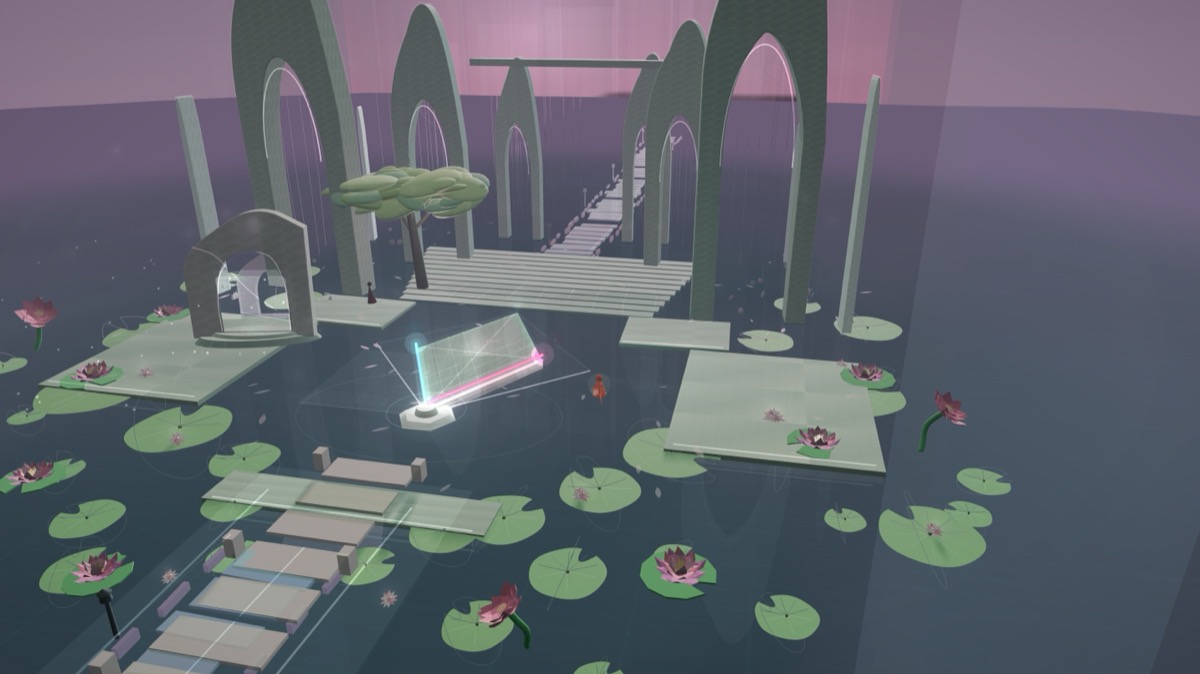
Wireframe render of the chapter-one oasis and archClay render of the chapter-one oasis and archLit render of the chapter-one oasis and arch
The arch & oasis · procedural — nested threshold geometry · wire / clay / lit
Wireframe render of the lotus courtClay render of the lotus courtLit render of the lotus court
Lotus court · procedural — vein shader, two-sided sign material · wire / clay / lit
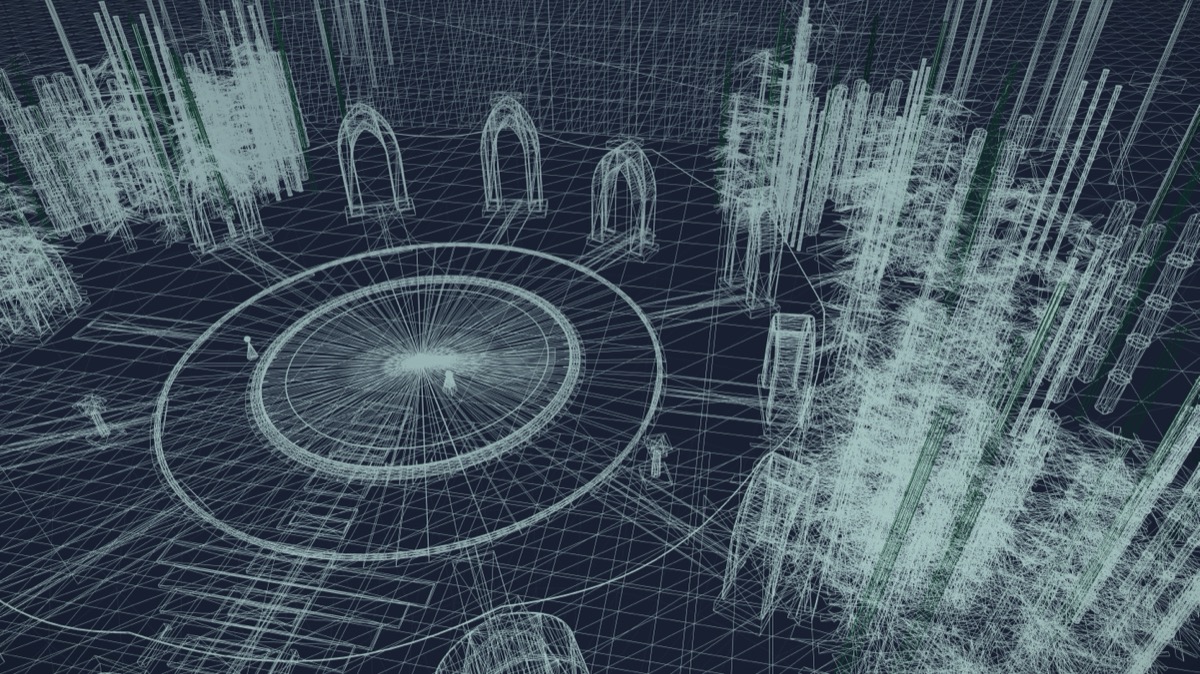
Wireframe render of the moon-dial courtClay render of the moon-dial courtLit render of the moon-dial court
Moon-dial court · procedural — 72 fine + 12 coarse ticks, λ ring, 12 gates · wire / clay / lit
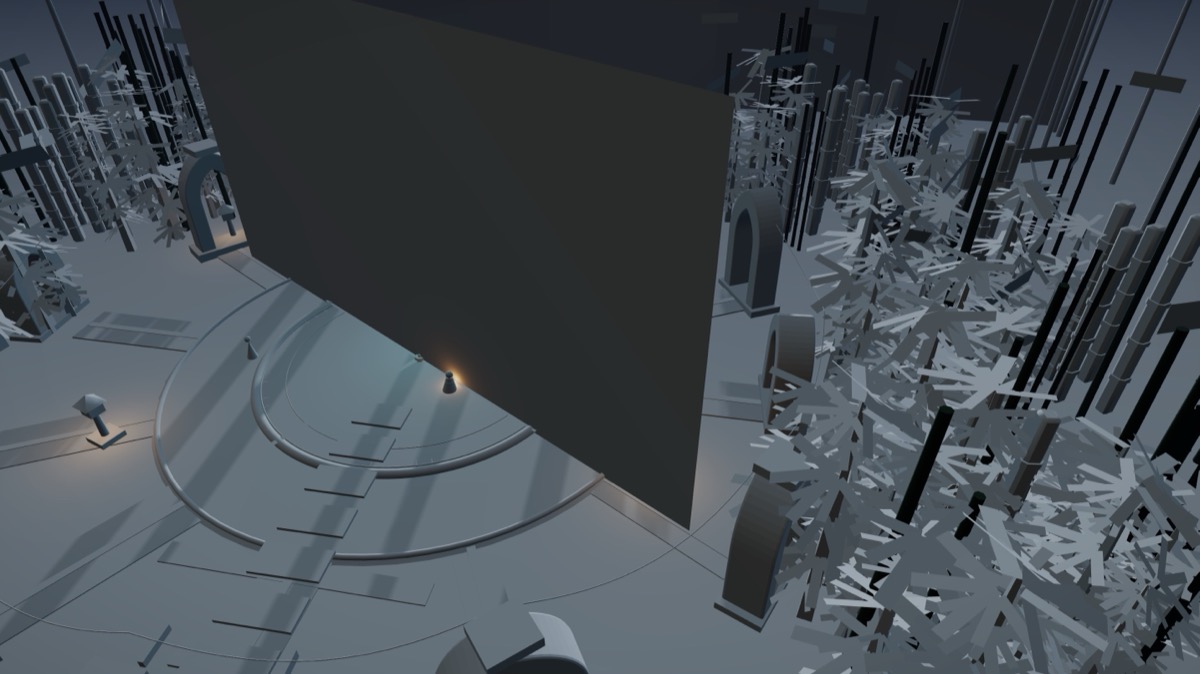
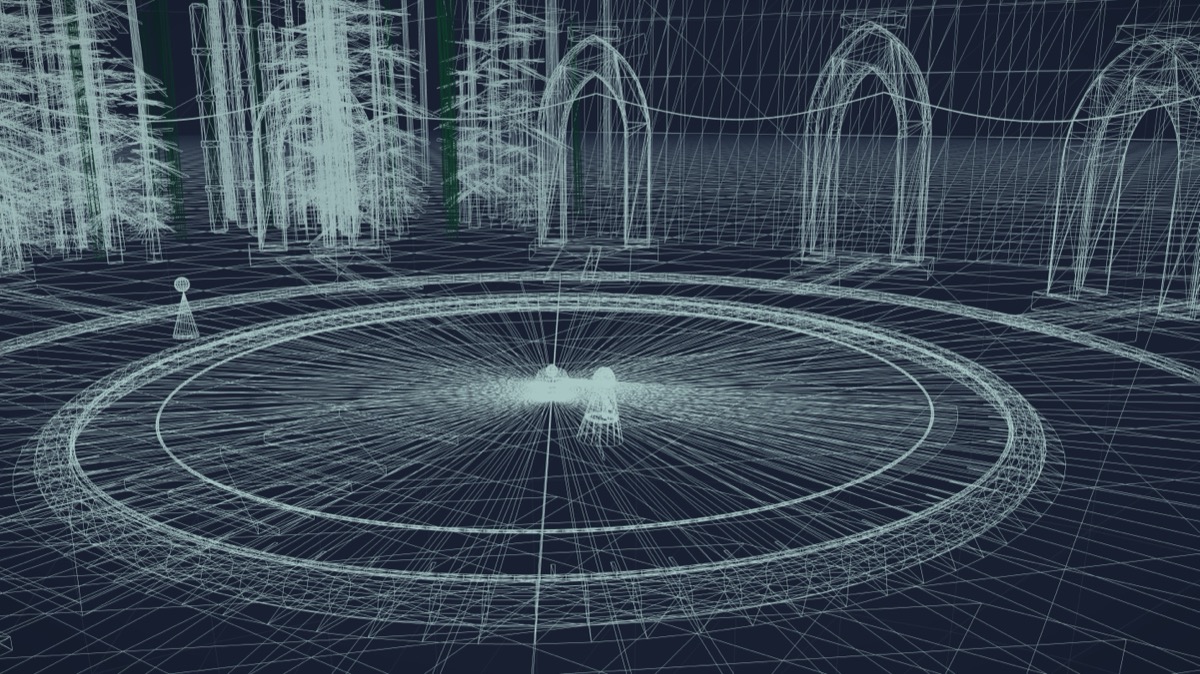
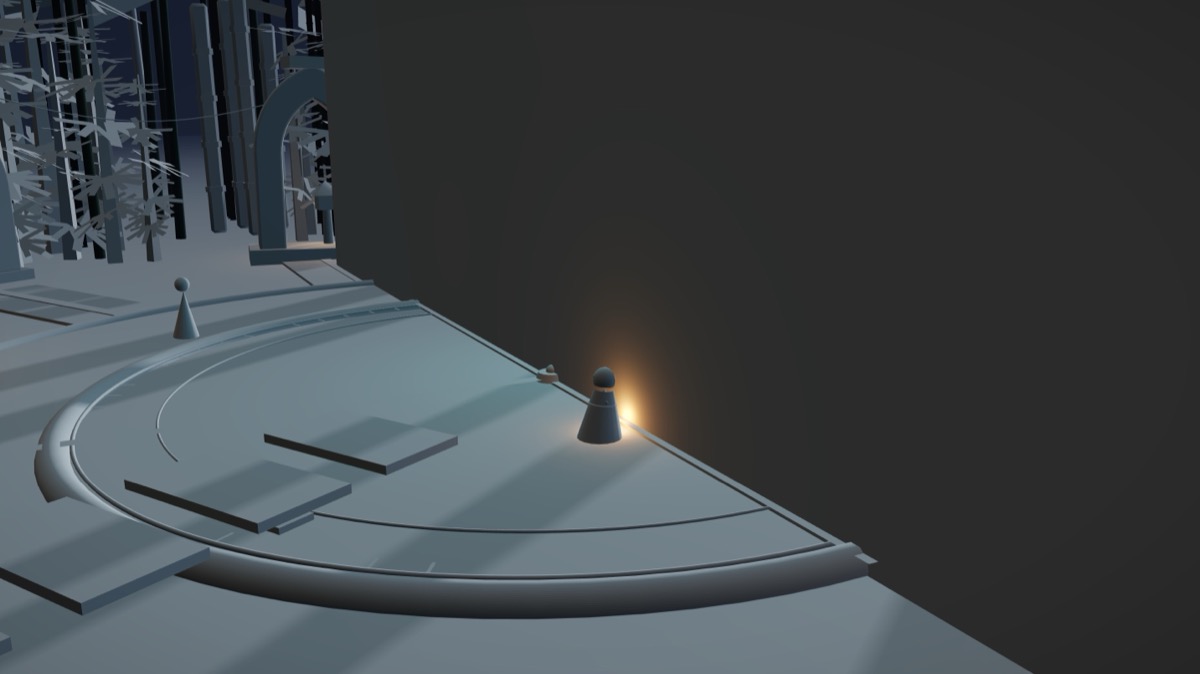
Wireframe render of the traveler on the dialClay render of the traveler on the dialLit render of the traveler on the dial
The traveler, in place · procedural — hood, cone, verlet scarf, lamp · wire / clay / lit

05 · Gameplay — one garden, one day, three thresholds

The formula stays precise.
The task becomes spatial.

Every chapter keeps one exact identity on screen and turns its terms into things two people can hold. The pass conditions are quantified and always visible: a full bar always means Space works.

Union Bridge

Three-phase ramp — one skill at a time

r = u + v
Length onlyreach the gate ring
WS
Angle onlypoint at the gate
AD
Compose u + vland r in the gate's heart
A/DW/SJ/LI/K

WIN · ‖r − target‖ < 1.2 · bar full ⇔ Space

Union Bridge gameplay with full HUD
Real gameplay · Union Bridge
u · U v · V r = u + v GATE TWO HANDS · ONE RESULTANT · ‖r − target‖ < 1.2

On confirm, a traveler walks the bridge the players just built — vector addition becomes a path you watch being walked.

Measuring Court

u, v become the columns of A — spanning signed area

det(u,v) = uₓv_y − u_yvₓ
·
Tune u / tune vor drag vector tips directly
A/DW/SJ/LI/K
·
Swap columnswatch the sign flip — court mirrors underwater
X
·
Replay · matrix input · fine-tunedet = 0 collapse triggers the degeneracy card
EMShift

WIN · det > 0 ∧ (resonance > 0.88 ∨ |det − 47.08| < 3.2)

Measuring Court gameplay with full HUD
Real gameplay · Measuring Court
+det u v ⇄ X −det det = 0 · COLLAPSES TO LINE LEAF = + · UNDERSIDE = − · TARGET +47.08

Positive area is a green lotus leaf; push the vectors toward collinearity and the floating platform collapses into a line.

Resonance Axis

Two invariant axes, each locked in two steps

Ax = λx
U
Set directionrotate x until Ax lies back on its axis · < 5.7°
A/DSpace
V
Set scaleslide gold bead λ̂x onto Ax's tip · ±18% · res < 0.20
I/KSpace
M
6 tiered matrix presets★ gentle stretch → ★★★ near-singular · free input
M

WIN · lock both axes (repeated root: one) · chimes ring the lock

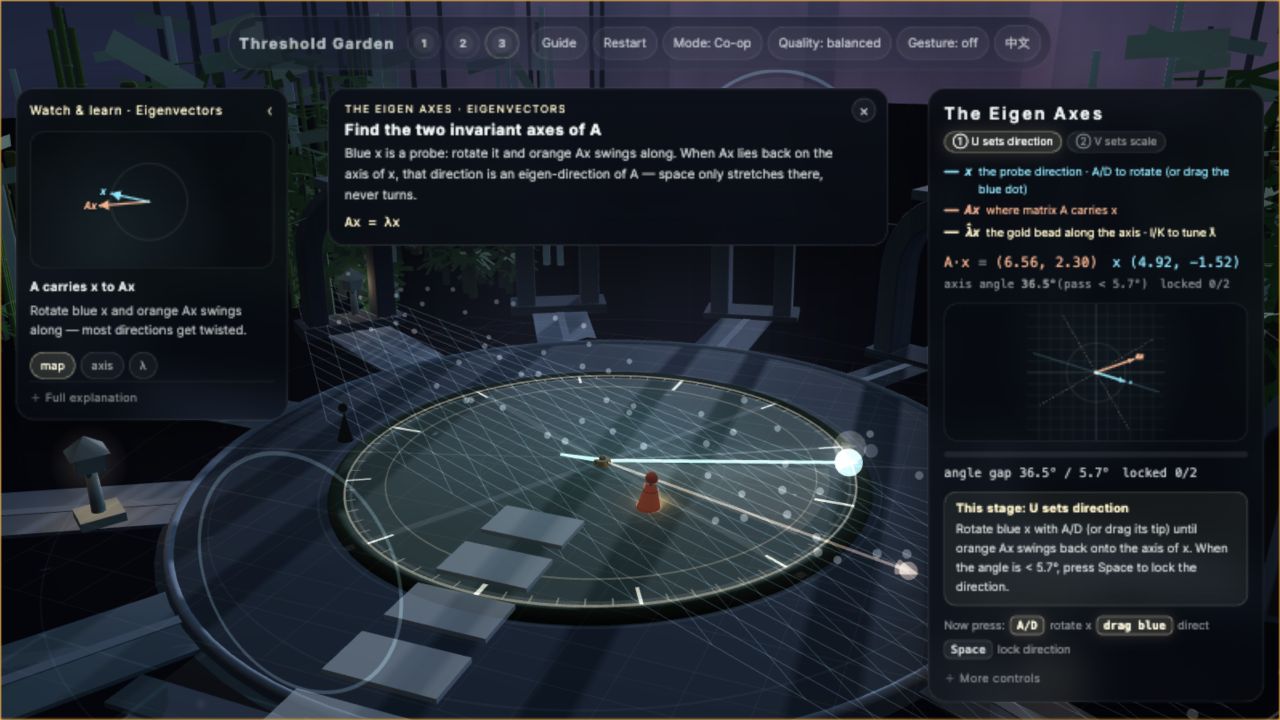
Resonance Axis gameplay with full HUD
Real gameplay · Resonance Axis
x Ax gap → 0 TWO HANDS ON ONE DIAL · < 5.7° · λ ± 18% · res < 0.20

Moonbeam curtains stand along the theoretical eigen-axes and brighten as you approach — the math glows before you reach it.

Co-op · defaultU + V

U owns direction / column 1, V owns scale / column 2. Space is a shared ritual — both must mean it.

Solotwo hands

One toggle: "left hand u / right hand v." Demos never depend on a second player.

GestureMediaPipe

The same split maps to bare hands on camera — pinch for length, turn for angle.

Final gameplay · four key moments — live loops captured in-engine

The traveler crossing the vector bridge at dusk
MOMENT 01 · DUSKThe walk across r

The traveler crosses the vector bridge the pair just composed — addition, made walkable, applauded by no one but the water.

The lotus court flipping to its cold-blue underside
MOMENT 02 · DAYThe leaf flips

Swap columns and the courtyard mirrors underwater — the lotus leaf shows its cold-blue underside. Sign = orientation, written in material.

The eigen axis alignment moment at night
MOMENT 03 · NIGHTAlignment, audible

Ax sweeps as x rotates; at alignment three lines collapse into one, the moonbeam brightens, and a single chime confirms what the eyes suspected.

Fireflies rising and the knowledge chain at the ending
MOMENT 04 · ENDINGFireflies & the chain

Moonlight turns gold, fireflies rise, and the three-chapter knowledge chain appears in one line: r = u + v → det(u,v) → Ax = λx.

06 · Interface — intuition in the world, precision at the edge

Actual game UI · three layers

Three layers.
One mathematical state.

The 3D world carries intuition; the edges carry precision. All three layers redraw every frame from the same state object — nothing on screen can disagree with the math.

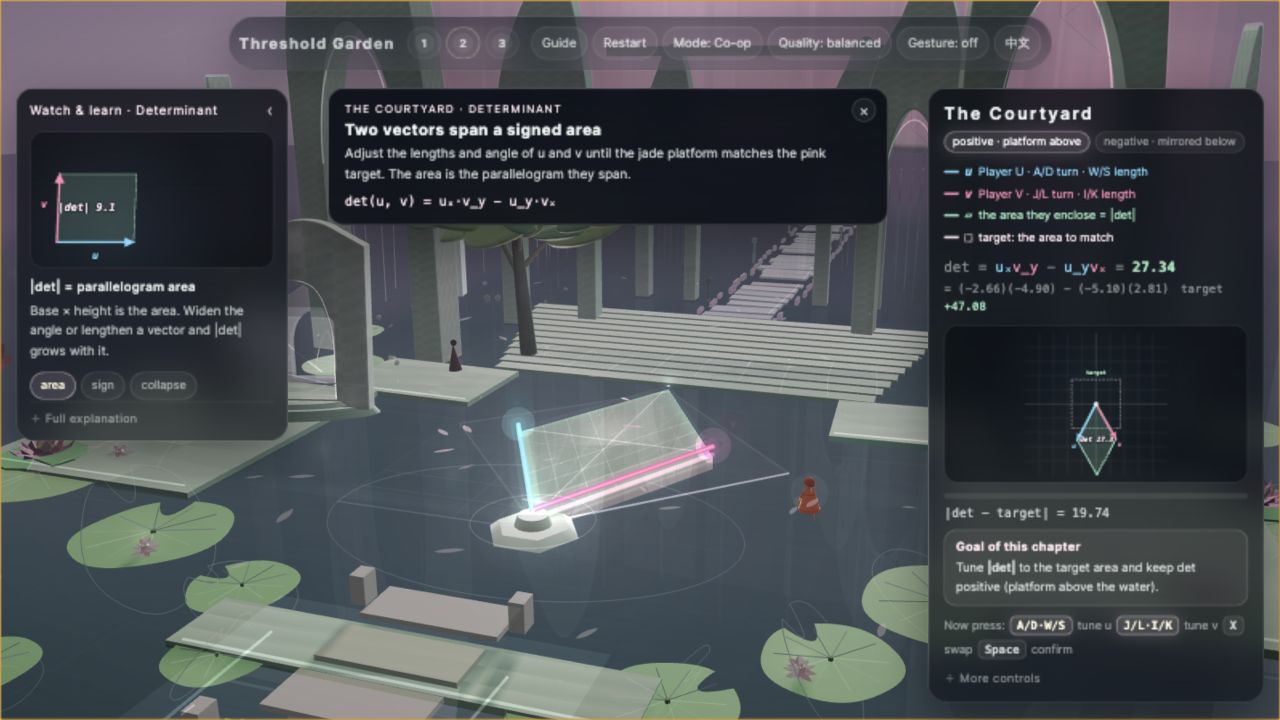
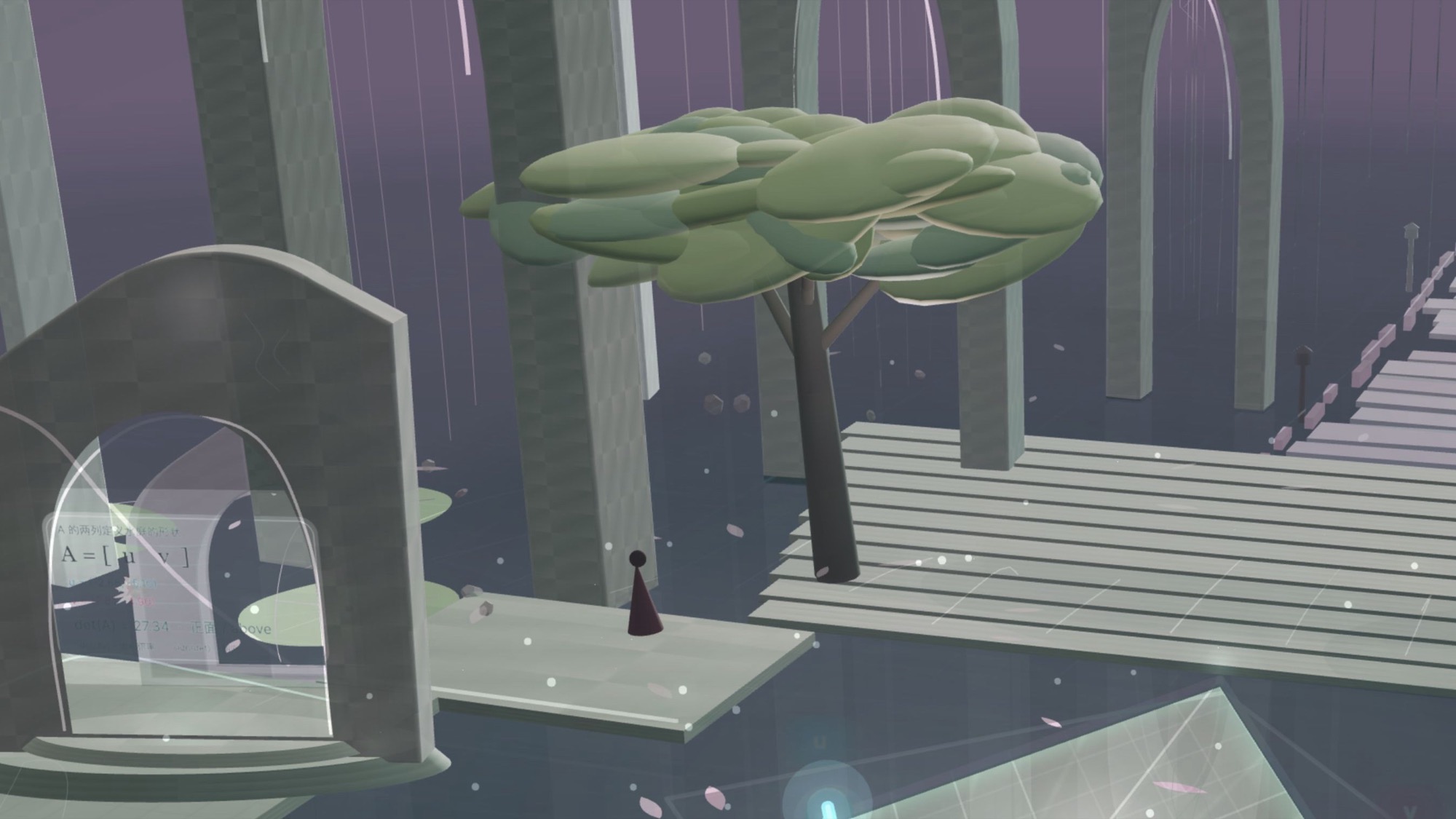
Real Chapter 2 gameplay frame showing learn panel, event teaching card and precision HUD around the 3D court A B C
One real frame, Chapter 2 · the world stays in the middle; teaching lives at the edges. All three layers redraw from the same state object every frame.
A / REFERENCE

Learn panel

A small looping concept animation, one sentence, and concept tabs (area · sign · collapse). It auto-focuses as the phenomenon changes — reference, not lecture. Ten hand-built loops cover length, angle, composition, area, sign, collapse, eigen sweep and λ.

B / JUST IN TIME

Event teaching card

Appears when the player causes a phenomenon, never on a timer: first negative det → "sign = orientation"; first near-collinearity → "area collapses into a line." The formula is introduced at the moment of consequence.

C / PRECISION

Equation + plot + threshold

The right edge exposes live value-substituted equations (det = 27.34 in this frame), orientation, 2D geometry with labeled tips, remaining error against target +47.08, the keys, and the confirm state. A full bar always means Space works.

Input pipeline · three hands, one state

KEYBOARD W/S · A/D · J/L · I/K · Space DIRECT DRAG vector tips · true handle height HAND GESTURE MediaPipe, vendored · webcam ONE STATE u · v · A · error damped & forgiving world panels SHAKY HANDS LAND ON THE SAME MATH AS STEADY ONES — INPUT IS COARSE, DAMPED, INTERCHANGEABLE

State routing · one source of truth, four outputs

MATH STATE u, v, A, error updated every frame WORLDmaterial + motion EQUATIONvalues + symbols PLOT2D comparison CARDcause explained notice verify compare name it SAME STATE, DIFFERENT JOBS — A TEACHER READS WHO IS STUCK WHERE FROM ACROSS THE ROOM
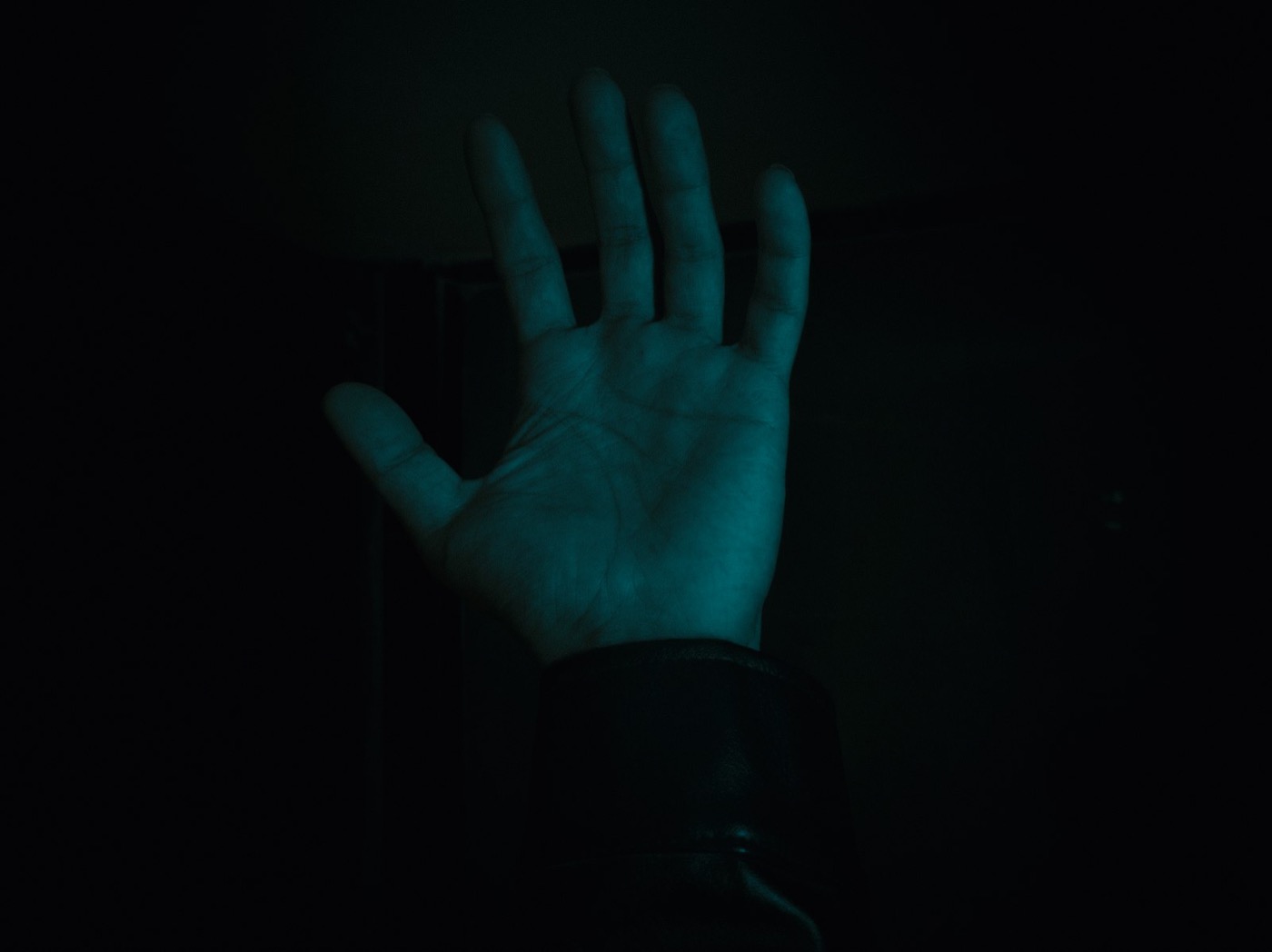
An open palm raised in the dark, lit by the cool glow of a screen

Hands as controllers · verified on device

The camera is the third input.

MediaPipe hand tracking is vendored into the build and runs entirely on the player's machine — no video ever leaves the laptop. A pinch reads as length, a turn of the wrist as angle, and both feed the same damped state as the keys, so a shaking hand still lands on the same mathematics.

Tested live on a physical webcam · the same U / V split, no keyboard required.

Five learning-design principles

01

Dual representation, always in sync

3D carries intuition; 2D carries precision. Both redraw from one state, every frame.

02

Event-driven teaching

Explain at the moment of cause, never as a front-loaded lecture.

03

Collapsible reference

Help stays available without occupying the world.

04

Art as feedback

Materials, light and sound repeat the mathematical state.

05

Transparent judge

Pass conditions are quantified on screen — no guessing what the game wants.

What changed · interface iteration ledger

tutorial as a wall of textthree-phase ramp + collapsible help
sliders and keys onlydirect drag + keys + hand gesture
win condition hiddennumber, bar and action always agree
"match length" in Ch.3 (wrong model)tune λ; win = residual ‖Ax−λx‖/‖x‖

07 · Architecture & craft — the system behind the garden

Technique solution

Three sovereign levels.
One continuous world.

three.js r160 WebAudio synth pure front-end · no build step custom shaders · caustics / sky / moon halo MediaPipe tasks-vision · vendored 5 low-poly models · 745 KB · CC0/CC-BY

FIG · continuous single-scene architecture

ROOT SHELL · main.js + unified-game.js transitions · HUD routing · fog, exposure & per-chapter fill light RUNTIME SOURCE TRANSFORM fetch level source → strip imports → inject THREE / Orbit / GLTF → register levels/01 Union Bridge · dusk own camera · state win: ‖r − t‖ < 1.2 levels/02 Measuring Court · day own camera · state det > 0 ∧ |det − 47.08| < 3.2 levels/03 Resonance Axis · night own camera · state < 5.7° · ±18% residual < 0.20 shared/math-ui-kit.js · per-frame `math` object · same module in solo & unified LEVELS STAY SOVEREIGN; THE SHELL OWNS WHAT MUST BE CONTINUOUS · IFRAME PATH KEPT AS FALLBACK

Why it matters · three bets

01
No build step

Any static server runs it — classrooms don't have npm. python3 -m http.server is the whole deploy.

ACCESS
02
Source transform over rewrite

Three finished standalone levels were injected, not rewritten — atmosphere ported wholesale, regressions isolated per level.

VELOCITY
03
State persisted, judged transparently

Progress survives refresh; every threshold is visible. Trust is a technical feature.

TRUST

Performance forensics · the cinematic hitch

Draw calls fell 3×. Frame time rose 4×. The bottleneck was never the objects.

DURING THE REVEAL WINDOW (t ≈ 1.2–2.9 s) draw calls 1,444 434 triangles 917 k 708 k frame time ~7 ms 27.7 ms THE EXPERIMENT pixelRatio 1.12 → 0.4 frame time 27.7 → 6.0 ms scales with pixel count → fill-bound, not object-bound Per-pixel cost: 13 standard-material lights on a full-screen close-up, plus water and additive glow overdraw. Hiding water (−20%), glow (−18%), particles (0) and shadows (0) never moved the needle — the pixels did.

The fixes · measured before → after

Reflection pass during cutscenescapped at 20 Hz only while the camera flies · normal play untouched
3.13 → 0.78 ms
Scarf idle jittertraveling ripple moved out of the physics solver — geometry only
3.98 → 0.10 u/s · ÷39
Traveler updates in transitownership: the shell holds the walk; levels yield
2 → 1 call / frame
Traveler buried in the marker stonefoot height blended deck ↔ stone-top by horizontal distance
0.71 u → 0 frames below

Cutscene resolution governor

1.000.820.68

Drops a tier below 51 fps, restores above 69, with a 1.1 s cooldown — active only during cinematics, where the camera is flying and softness is invisible. Capable machines never leave 1.00.

The other hitch · shader compilation

The 1–2 s freeze at chapter hand-off was programs compiling on first sight. Prewarm only works if it reproduces the real light configuration — light count is part of the program cache key. Verified objectively with renderer.info.programs.

Sound as judge: Ch.3's wind chimes are decoration and an audible win condition — higher resonance, livelier sway, denser tings. Locking a direction plays one clear note; locking an axis, a pentatonic arpeggio (WebAudio sine + detuned triangle).

08 · Process — drafted, broken, rebuilt

My V0 was three separate mini-apps behind iframes — correct math, no garden.

The draft proved the math pipeline. Everything spatial — continuity, atmosphere, one garden growing across a day — came from iteration. Every pass shipped with notes; the full ledger lives in the project documentation.

"Iteration you can't audit is just churn."working principle · 7 documented passes + 30 logged commits

APR → AUG 2026 · 7 documented passes · 30+ logged commits in the final sprint · ≈27,000 lines of hand-written JS / CSS / HTML · zero-dependency deploy

The first draft L1.HTML L2.HTML L3.HTML three rooms, no corridor — players reloaded between concepts IFRAME SWITCHING · SEPARATE CAMERAS · SEPARATE STATE
The current build Current build: one continuous garden, opening view

One world; the camera travels through all three chambers.

What the draft taught us · V0 → current

Three scenes, hard cuts

One continuous garden, camera travels

world model

Tutorial as wall of text

Three-phase ramp: length → angle → compose

learning

Ch.3: "adjust length" (wrong model)

V tunes λ; win = residual ‖Ax−λx‖/‖x‖

mathematical model

Sliders only

Direct drag on vector tips + keys + gesture

interaction

Guess the win condition

Quantified thresholds; bar full ⇔ Space

clarity

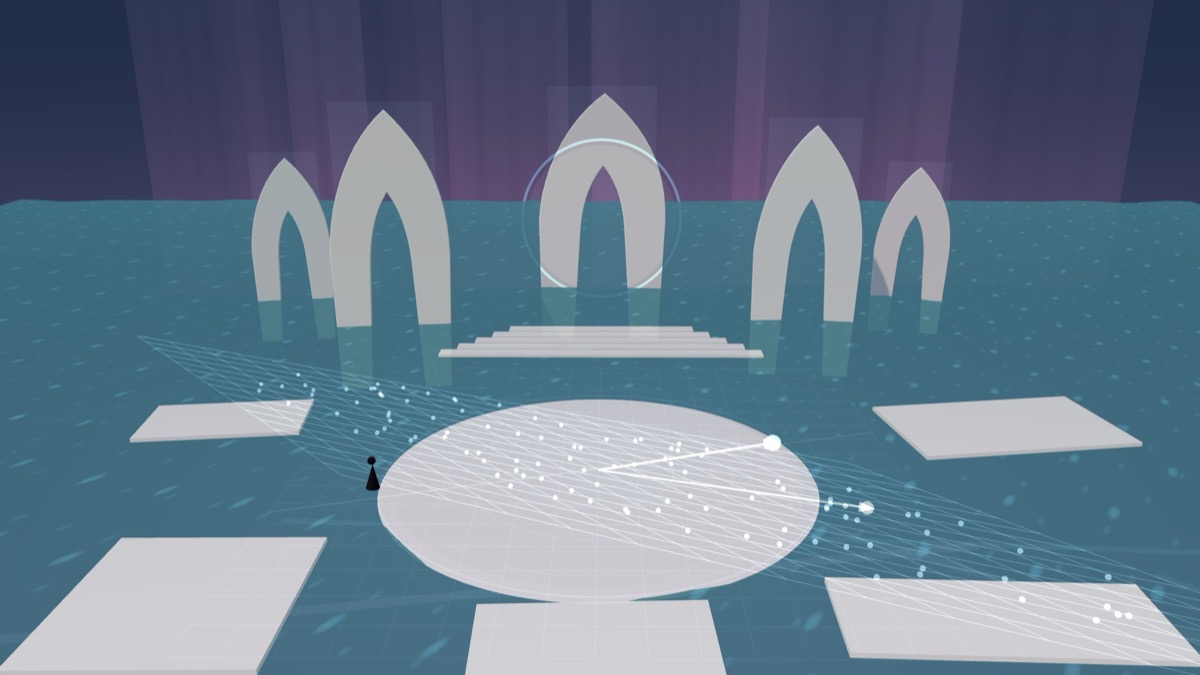
The same three rooms, four builds apart · real captures from surviving builds

May build: chapter one as an arch island floating in a flat night void
2026-05 · Ch.1, standalone — an island in a void; no dusk, no dunes, no traveler
May build: chapter two, the courtyard before the lotus language
2026-05 · Ch.2, "channel edition" — the court before the leaf language
May build: chapter three before the moon-dial court
2026-05 · Ch.3, "seamless edition" — axes without a dial to read them
Current build: chapter one in full dusk art
2026-08 · Ch.1, current — the same math, now a place

Seven documented passes · 2026-04 → 2026-06

Concept & paper sketch2026-04 · cut-outs before code Three standalone levels · V02026-05 · math right, worlds apart Math consistencyCh.3 → λ & residual Interaction repair2026-05-25 · draggable tips Continuous single-sceneone garden, no iframes Clarity & stabilitySpace routing · gap lines Major overhaul · 5 sub-passes2026-06-11 · one-day systematic rebuild
P0Critical fixes

Main entry silently served a degraded fallback to every player; canvas races; bar/confirm mismatch.

P1Math panels ×3

Shared scaffold extracted; Ch.2/3 gained full equation + plot panels in both run modes.

P2Lotus court

Leaf-language platform: vein shader, cold-blue underside for negative area, resonance blooming.

P3Bamboo night

Starfield, moonbeam eigen-axes, chime system, firefly ceremony; presets 3 → 6.

P4–5Solo + models

Solo/co-op toggle; 11 low-poly models auditioned, 5 kept (745 KB).

Then the craft sprint · 30 logged commits in 6 lanes · 2026-06 → 2026-08

POST-FX PARTICLES CINEMATICS PLATFORM SCENE ART CHARACTER & STORY D4 · the 1–2 s hitch was shader compilation D6 · scarf idle jitter ÷ 39 MediaPipe hand gesture lands JUN 2026 · shared post-fx, particles, cinematic timeline JUL · gesture, i18n, audio, traveler controller, scene density AUG · Carrying-the-Lamp narrative & perf craft Each dot is one logged commit; the ledger lives in git. The story sprint is the longest lane — the character came last, once the world deserved him.
scenes3 → 1

separate mini-apps → continuous world

eigen presets3 → 6

tiered ★ → ★★★, repeated-root handling

models11 → 5

auditioned → kept · 745 KB

win checkquantified

every threshold visible on screen

09 · Evaluation — evidence, limits, and the next study

Heuristic evaluation · completed 2026-06-11

42 findings across five lenses gave the project a repair map.

Five dimensions, parallel reviewers, hands-on play. This was an internal audit — not a substitute for participant evidence — and every reported issue was checked against the live build before being accepted; false positives were closed without churn.

Findings by lens · all verified against the build

Learning
12
Functionality
9
Playability
8
Design
7
Art
6

42 logged findings

Finding 01

The polished levels never loaded from the main entry.

Import stripping was incomplete; the source transform failed silently, so every player received a degraded fallback.

Resolved · validated pipeline + per-level isolation
Finding 02

The resonance bar and Space disagreed.

The visible feedback and the confirm key ran on separate mappings.

Resolved · one mapping drives both — bar full ⇔ confirm enabled
Finding 03

det = 0 and sign flips passed silently.

The most teachable moments were visual effects with no conceptual bridge.

Resolved · event cards + material states fire at cause
Finding 04

The hardest chapter had the thinnest ending.

Eigenvectors offered little support and closed in under seven seconds.

Resolved · quantified two-step task + fourteen-second ritual

External playtest · planned

The protocol is ready. The field evidence is not.

No formal external playtest has been conducted yet. This section is deliberately a research plan, so future evidence can be added without rewriting the case study's claims.

6–10participants

Half with prior linear algebra, half without; at least two co-op pairs. Unaided three-chapter run.

03concept retells

After each chapter, participants explain the concept in their own words · scored on a 0–2 rubric.

05signals

Time per chapter · stuck points (> 60 s) · card read-rate · retell accuracy · SUS.

Questions to test

H1Does the live 2D math panel improve concept retell accuracy?panel on / off A-B
H2Does Ch.3's direction → scale sequence reduce stalled time?timestamp phase transitions
H3Does splitting control generate productive mathematical talk?code think-aloud transcripts

45-minute session · run of show

00–05Consent + baseline05–10Control warm-up10–30Pair play + think-aloud30–38Concept retell38–45SUS + debrief
01 Observe02 Code03 Compare04 Revise
PHOTO 01Pair play · shared screen

Reserved for a wide contextual image: posture, shared attention, two control roles.

PHOTO 02Hands + think-aloud notes

Reserved for a close crop of physical interaction or facilitator notes.

Final display · line becomes bridge · plane becomes court · axis becomes gate

Final display: the Union Bridge at dusk
01 · dusk — the path across r = u + v
Final display: the Measuring Court in daylight
02 · day — signed area held above water
Final display: the moon-dial court at night
03 · night — direction becomes a hand on a dial

Honest limits

  • External participant testing remains to be completed.
  • Ch.2 water still lacks the real-time reflection used in Ch.1.
  • Wind-chime synthesis needs by-ear tuning with users.
  • Desktop keyboard first; touch and mobile are not yet supported.

Next

Run the two-group playtest, code concept-retell quality, and examine whether the co-op role split produces mathematical conversation rather than simple task division.

The contribution is not a claim that a game "solves" linear algebra. It is a designed hypothesis: when abstract operations become shared spatial acts, learners have more ways to notice, explain, and remember them.

Enter Threshold Garden ↗